

ESA Launches HydroGNSS Mission
Twin Satellites Will ‘Scout’ for Water

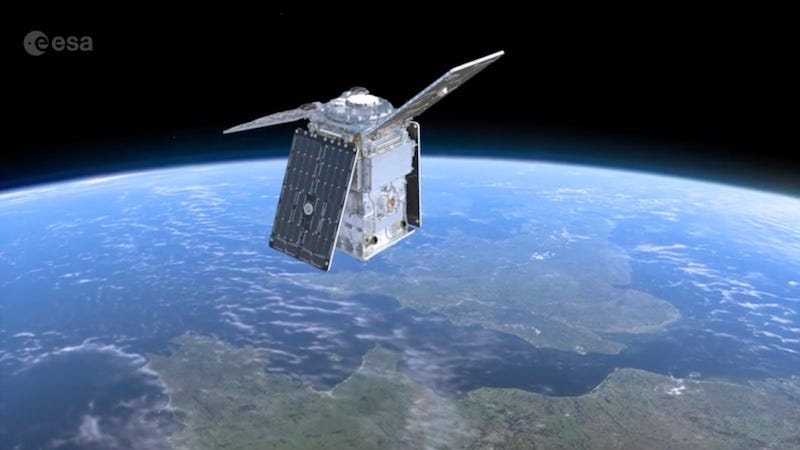
A pair of satellites were launched on the recent Transporter-15 mission that will give ESA the ability to better understand the global availability of water.
“We now look forward to seeing how HydroGNSS will employ GNSS reflectometry to deliver valuable insights into key hydrological variables that shape Earth’s water cycle.”
Simonetta Cheli, ESA
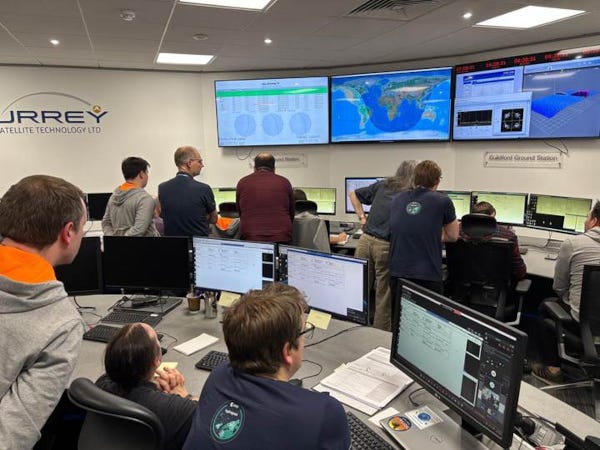
Less than 90 minutes after liftoff, the twin HydroGNSS satellites separated from the rocket. Then, at 22:45 CET, Surrey Satellite Technology Ltd (SSTL) in the UK confirmed that they had received signals, indicating that both satellites were safely in orbit around Earth. Both satellites will use an innovative technique called Global Navigation Satellite System (GNSS) reflectometry to quite literally ‘scout for water’.
This process involves the HydroGNSS satellites capturing L-band signals from navigation systems such as GPS and Galileo. These navigation satellites transmit L-band microwave signals that change when they are reflected off Earth’s surface.
The HydroGNSS satellites will compare these reflected signals with the signals the satellites receive directly from the GNSS satellites to reveal valuable information about the properties related to the water cycle, and more.
To do this, each satellite carries a delay doppler mapping receiver. This consists of two antennas: a zenith antenna, which tracks direct GNSS signals and a nadir antenna, which collects reflected signals and processes them into delay Doppler maps. Using this technique, these two small satellites, which orbit Earth 180 degrees apart, will measure soil moisture, freeze–thaw state, inundation and above-ground biomass. This data will not only be vital for advancing our understanding of Earth’s water cycle, but also for supporting applications such as flood prediction and agricultural planning.
Also, by observing the extent of inundation and areas of wetland, HydroGNSS will help reveal wetlands – important ecosystems that can act as significant sources of methane – often hidden beneath forest canopies.
Information on freeze–thaw states will provide insight into the surface radiation balance, energy and carbon exchanges with the atmosphere, and the behaviour of subsurface permafrost in high latitudes. Meanwhile, data on above-ground biomass will contribute to estimates of forest carbon stocks and their role in the global carbon cycle.
Drawing inspiration from the spirit of New Space, the Scouts champion agility and innovation – harnessing small, smart satellites to shrink proven technologies or test bold new ways of observing our planet.
Each mission races from concept to launch in just three years, on a lean budget of €35 million that covers everything from design and construction to in-orbit operations.
“As the first of ESA’s Scout missions to launch, HydroGNSS marks an important milestone for this new family of rapid, low-cost Earth observation missions, and we extend our thanks to the mission’s prime contractor, SSTL,” said Simonetta Cheli, ESA’s Director of Earth Observation Programs. “The launch also represents a key step in the evolution of our FutureEO program, where the Scouts embody a fast, agile, innovative and cost-efficient approach – complementing our larger Earth Explorer research missions.
“We now look forward to seeing how HydroGNSS will employ GNSS reflectometry to deliver valuable insights into key hydrological variables that shape Earth’s water cycle.”
ESA’s prime contractor for the HydroGNSS mission is SSTL in the UK. SSTL is also responsible for operating the satellites in orbit and for distributing the data. The mission is also thanks to partial funding from the UK Space Agency.