

ESA Funding for “ASTRAL” Refueling Mission Awarded to Orbit Fab
Will Demonstrate Refueling Interfaces in a Realistic Docking and Propellant-Transfer Scenario

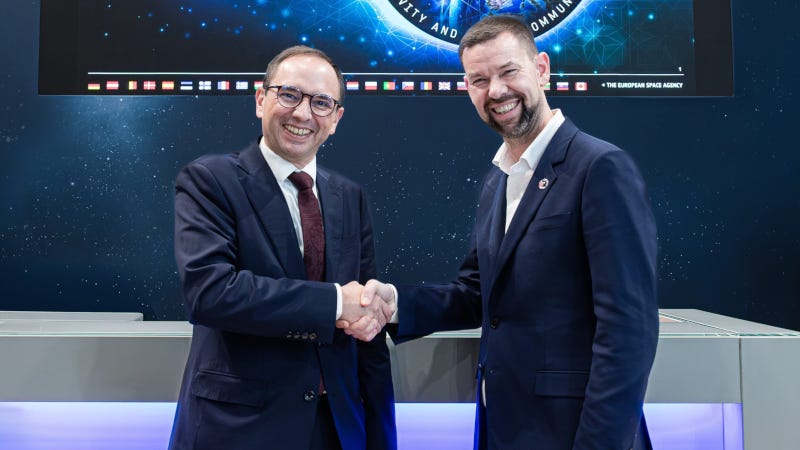
The UK Space Agency and European Space Agency’s (ESA) Directorate of Connectivity and Secure Communications has awarded up to $3.8 million to Orbit Fab to lead a European consortium advancing next-generation satellite refueling technology.
“Developing the European capability now is vital to extend the life of communication satellites and make defence spacecraft more manoeuvrable and resilient.”
Jacob Geer, Orbit Fab
Under the contract, Orbit Fab will deliver the Advancing Satcom Technology with Refuelling and Logistics (ASTRAL) project with a total UK funding of up to $3.8 million (€3.3 million). The contract for the first stage of the mission, worth £1.3 million (€1.1 million or $1.71 million U.S.), has now been awarded to Orbit Fab by ESA’s Advanced Research in Telecommunications Systems (ARTES) Core Competitiveness program.
ASTRAL will perform an in-orbit experiment by 2028 to de-risk and validate Orbit Fab’s RAFTI and GRASP refueling interfaces in a realistic docking and propellant-transfer scenario. The mission will establish the performance of these systems in its operational environment– a crucial step in proving the viability of sustainable satellite servicing and refueling.
“We are proud that Orbit Fab will lead Europe’s first in-orbit test of satellite refueling,” said Jacob Geer, Orbit Fab Managing Director of UK & Europe. “Through the support of the ESA ARTES we are bringing together technology developed in Austria, Lithuania, the UK and beyond with our proven RAFTI interface to conduct the world’s first in orbit fuelling of Xenon. Developing the European capability now is vital to extend the life of communication satellites and make defence spacecraft more manoeuvrable and resilient.”
“ESA is committed to supporting a vibrant and striving telecom ecosystem in Europe while achieving a zero-debris environment in space, which includes the development of technologies for in-orbit servicing and refueling,” said Laurent Jaffart, Director of ESA’s Connectivity and Secure Communications. “This milestone, which is enforced by top expertise from our colleagues at Orbit Fab and support from the UK Space Agency, builds on more than a decade in working towards a sustainable future in Earth orbit. ASTRAL – which will be an important test in the realisation of flexibility and extending mission lifetimes – is set to further strengthen the European autonomy and sovereignty that we are collectively striving for with our Member States.”
“The UK Space Agency is proud to support pioneering projects such as ASTRAL that showcase the depth of talent and innovation across the UK and European space sector,” said Craig Brown, UKSA Director of Investments. “In-orbit servicing and refueling could transform the way communication satellites operate over time, so investing in these new technologies, and fostering strong European partnerships in areas such as in-orbit refueling, we are helping to secure the UK’s position as a global leader in space, driving growth, and delivering benefits for industry and society alike.”
European Collaboration Driving Resilience and Space Sustainability
The ASTRAL consortium unites leading European innovators – Orbit Fab, KISPE Space Systems, Gate Space Innovation GmbH, Blackswan Space, and Indra Deimos – from the UK, Austria, Lithuania and beyond. Together, they will deliver Europe’s first in-orbit refueling experiment using Xenon, advancing the design, integration and validation of critical hardware needed to sustain and protect satellites in Space. As Earth’s orbit become increasingly congested and contested, ASTRAL will help strengthen Europe’s strategic resilience, enabling spacecraft to manoeuvre, extend mission life, and maintain operational advantage for the continent across commercial and governmental domains.
Over the course of the mission, ASTRAL will demonstrate a complete series of in-orbit servicing operations, beginning with a mechanical docking and leak-free connection between a servicing and target spacecraft using Orbit Fab’s GRASP and RAFTI interfaces. The mission will then transfer multiple propellants – Nitrous Oxide (N2O), Ethane, and Xenon – through RAFTI, proving the system’s versatility and robust capacity. The mission will then attempt to safely validate docking, refueling, rendezvous and proximity operations and safe release procedures to confirm reliable performance in a true orbital environment.