

Embedded Partners
How India, the UAE, and Brazil Are Reshaping U.S. Space Supply Chains — and the Compliance Costs You Haven’t Priced In Yet

WHAT THIS MEANS
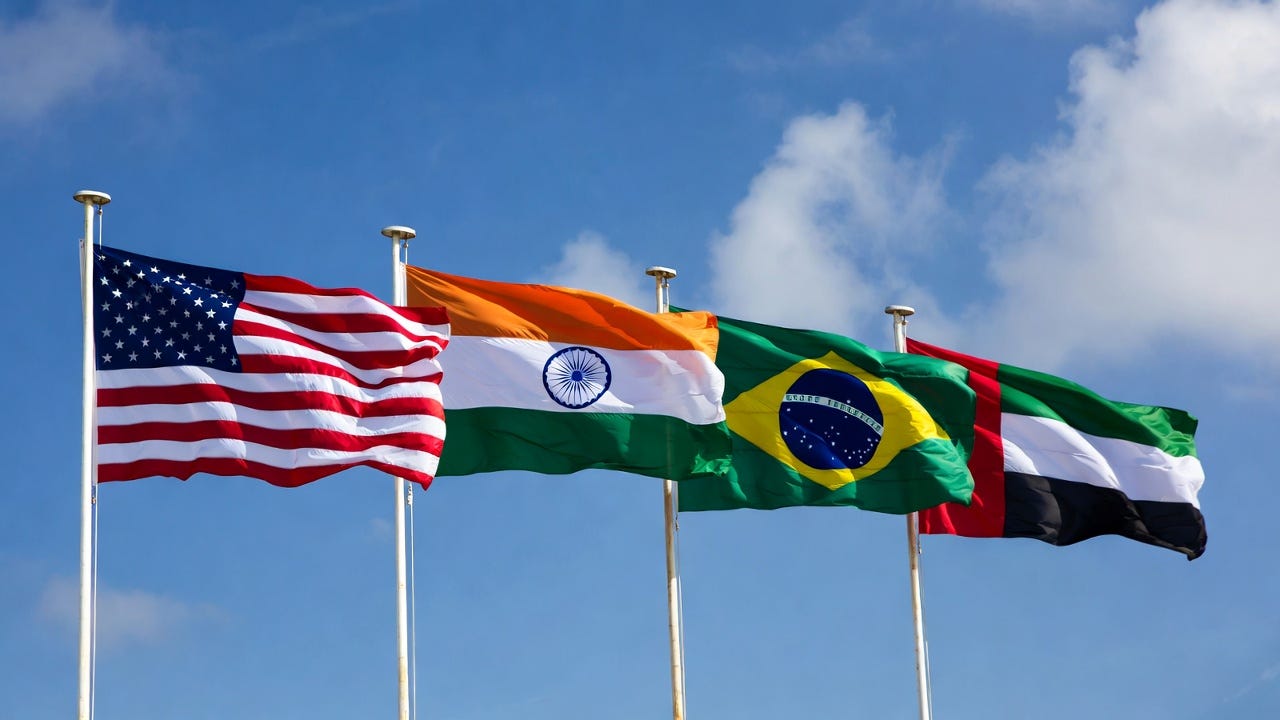
The U.S. government organized its first commercial space trade mission to India in February 2026, bringing 14 named U.S. firms to Bengaluru the same quarter the UAE signed two bilateral supply-chain frameworks with Washington and Brazil completed the governance structure that makes Alcântara Launch Center commercially viable for U.S.-technology payloads. These are not three separate bilateral stories — they are a coordinated industrial policy play, and U.S. supply-chain leaders who are not already structured for ITAR-compliant teaming in all three markets risk watching competitors establish preferred-partner status before the window narrows.
Your business development team comes back from a conference with a promising lead: an Indian satellite bus manufacturer in Bengaluru with government backing, cost structures well below your current suppliers, and a growing track record of on-orbit hardware. Three months later, your legal department is still working through the ITAR licensing question. The BD team has moved on to the next shiny thing. The Bengaluru firm signed an MoU with one of your competitors.
That story is playing out repeatedly right now, and it will accelerate. The U.S. government is not just encouraging American companies to engage with space programs in India, the UAE, and Brazil. It is actively engineering the commercial and diplomatic scaffolding to make those partnerships happen. The question is whether U.S. supply-chain leaders are moving at the same pace as the policy machinery, or whether they are going to spend 2026 watching competitors establish preferred-partner status in markets that will matter enormously by 2028.
This piece maps what has actually been structured, what remains incomplete, and what the specific compliance and concentration risks look like for U.S. firms that are serious about these three markets.
Three Signals, One Quarter
The easiest mistake to make right now is to treat U.S. engagement with India, the UAE, and Brazil as three separate bilateral stories. It is more useful to read them as a coordinated industrial policy play. Three near-simultaneous developments in Q4 2025 and Q1 2026 make that case.
In India, the Office of Space Commerce organized the inaugural U.S.–India Space Business Forum in Bengaluru on February 10 and 11, 2026. The attendance list was not a panel of consultants and trade attaches. It included ISRO Chairman Dr. V. Narayanan and representatives from 14 named U.S. companies: SpaceX, Amazon, Axiom Space, BlackSky, Planet, Viasat, Vantor, Umbra, and Vast Space among them. More than 200 government and industry participants attended across both days. The Forum did not materialize from nowhere. OSC had published a formal call for stakeholder input in January 2026, soliciting seven categories of feedback on market-access barriers, including FDI restrictions, EO data-sharing limitations, and licensing friction in the Civil Space Joint Working Group framework. That is not the language of exploratory dialogue. That is pre-negotiation homework.
In the UAE, two frameworks came online within weeks of each other. On January 14, Qatar and the UAE formally joined the U.S.-led Pax Silica Declaration, a U.S.-organized initiative aimed at building resilient, China-independent AI-era technology supply chains through coordinated investment, infrastructure development, and international partnerships. Three weeks later, on February 5, the UAE and the U.S. signed a separate Critical Minerals and Rare Earths Supply Chain Framework, committing both governments to jointly identify priority projects, establish financing mechanisms, streamline permitting, and begin delivering end-products to buyers in both markets within six months of signing. These agreements sit on top of the UAE–U.S. Framework on Advanced Technology Cooperation, which established a joint working group back in May 2025 with a mandate covering AI, semiconductors, and dual-use technology pathways.
In Brazil, the change is quieter but potentially more operationally significant for launch-dependent programs. Brazil ratified its Technology Safeguards Agreement with the U.S. in March 2022, which was the legal foundation that allowed American technology to be used at the Alcântara Launch Center without triggering export-control violations. But the TSA ratification, on its own, did not solve the multi-agency access problem that had frustrated commercial operators for years. That changed in November 2025, when the Brazilian Space Agency, the Brazilian Air Force, and the Alcântara Launch and Administration Department signed a five-year Technical Cooperation Agreement that consolidated the permitting and access process under a coherent commercial framework. Within weeks, the framework was tested: a South Korean commercial operator conducted Brazil’s first orbital commercial launch attempt from Alcântara in December 2025. Alcântara is a near-equatorial launch site. The orbital mechanics advantage is real and measurable — payloads launched from Alcântara to geostationary orbit carry roughly 15 percent more mass than the same rocket launched from Cape Canaveral. That is not a rounding error when you are pricing a satellite launch campaign.
Three countries. Three different entry points. All moving in the same direction within the same calendar quarter. The policy signal is clear. The supply-chain question is whether your firm has a strategy that matches the signal.
