

Elon City, Mars
Why the first city on Mars should be named after the first trillionaire on earth

Brand: Space Column Special
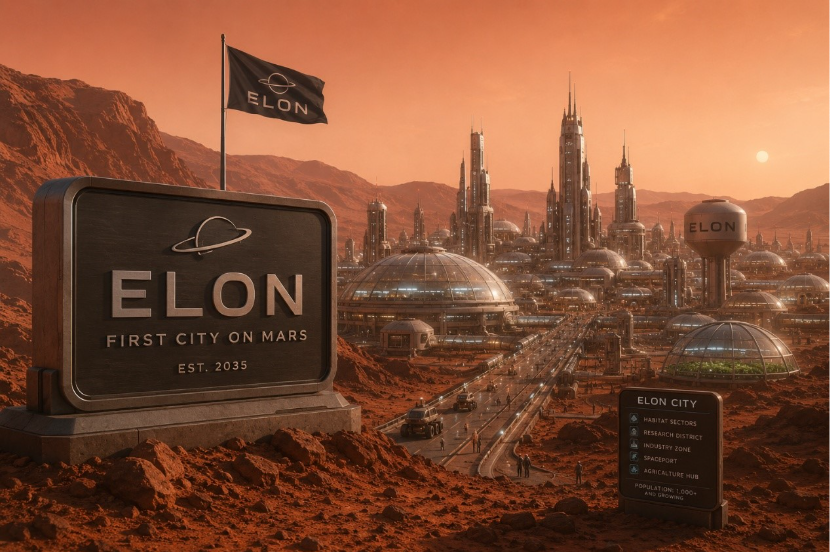
First, I do not work for, or receive compensation from, any Musk-owned organization, nor do I own any Musk-associated products. But I am a fan.
There is a moment in the development of every civilization when symbolism becomes strategy. Rome understood it. Constantinople understood it. Washington understood it. The names we assign to cities are never accidental. They are declarations of values, ambition, power, sacrifice, and identity. They tell future generations who mattered enough to be remembered when history crossed a threshold.
Mars will not merely be another destination. It will represent the single greatest expansion of human civilization since humanity first crossed oceans and settled new continents. The first permanent city on another world will become one of the most historically significant places ever created by human hands. Which raises an unavoidable question: who has done more to make that city possible than Elon Musk?
For all the criticism, polarization, political arguments, and internet noise surrounding Musk, history tends to simplify what matters most. The Wright brothers were not remembered because everybody liked them. Thomas Edison was not remembered because he was universally admired. Admiral Rickover was not remembered because he was easy to work with. They are remembered because they fundamentally altered the trajectory of civilization.
Musk has done exactly that for spaceflight.
Before SpaceX, the global space industry had become operationally stagnant. Launch costs remained extraordinarily high. Human spaceflight lacked urgency. Mars existed primarily as a PowerPoint aspiration discussed at conferences and academic symposiums. The industry had become comfortable talking about the future instead of building it.
Then came Falcon 9 landings.
Then reusable rockets.
Then Starship.
Then the return of public excitement surrounding space exploration on a scale not seen since Apollo.
One can argue about Musk’s management style, politics, social media behavior, or public persona. None of those debates change the larger strategic reality: no individual in the modern era has done more to transform space from a government-dominated prestige activity into an industrialized, scalable, civilization-building enterprise.
Naming the first city on Mars “Elon” would not merely honor a man. It would honor the catalytic role entrepreneurship played in reopening humanity’s frontier instinct.
More importantly, it would send a powerful signal to the next generation of innovators.
The modern space industry desperately needs mythology.
Not fantasy. Not science fiction. Mythology in the civilizational sense. Shared stories. Shared heroes. Shared symbols that inspire people to pursue difficult things over long periods of time.
The space industry often struggles with emotional storytelling. It communicates specifications better than significance. It explains propulsion systems better than purpose. Yet human beings do not sacrifice for technical diagrams. They sacrifice for meaning.
A city called Elon on Mars would instantly become one of the most powerful symbolic narratives in modern history.
Children would ask why it was named Elon.
Teachers would explain the rise of reusable rockets.
Entrepreneurs would study how private industry accelerated space development.
Engineers would see proof that radical ideas can reshape civilization.
Investors would recognize that long-term visionary thinking can alter history itself. Recent public sales of SpaceX stock have demonstrated just how much value global markets now assign to the future of space development. Those transactions helped propel Elon Musk’s net worth beyond the trillion-dollar threshold, making him the first trillionaire in human history.
Whether one views such wealth as inspirational or controversial, it represents something unprecedented: the first time financial markets have attached civilization-scale economic value to the expansion of humanity beyond Earth. In many respects, that valuation reflects not only confidence in a company, but confidence in a vision that transformed Mars from a distant scientific aspiration into a credible destination for permanent human settlement.
Most importantly, the public would emotionally connect to the reality that humanity had finally become multiplanetary.
There is also strategic branding value in such a name that many critics underestimate.
The space industry is entering an era of global competition not only technologically, but culturally. Nations, companies, and alliances are increasingly competing to shape the narrative architecture of humanity’s future in space. Whoever defines the emotional language of space exploration will possess enormous influence over public support, investment flows, recruitment, and international prestige.
“Elon” is already globally recognized. It is instantly associated with rockets, innovation, Mars, engineering ambition, and technological disruption. From a branding perspective alone, the name carries extraordinary communicative power. And, best of all, it sounds “Martian.”
I really like “Elon” from a branding perspective, “Musk” has a number of image challenges, whereas “Elon” has a romantic, poetic sound like “Avalon.”
People remember names that symbolize movements: Ford, Disney, Tesla, Apollo.
A Martian city named Elon would immediately embed itself into global consciousness in ways that sterile technical designations never could.
Critics will inevitably argue that no individual deserves that level of recognition while still alive, or that Mars should belong symbolically to all humanity rather than one entrepreneur. Those concerns are understandable. But history shows that pioneering eras are often defined through individuals who concentrate momentum around impossible goals.
Magellan did not circumnavigate the globe alone.
Apollo was not achieved by a single astronaut.
Yet history still attaches defining names to transformational endeavors because people serve as narrative anchors for civilizational progress.
The reality is simple: if humanity establishes a permanent city on Mars within this century, the fingerprints of Elon Musk will be all over it.
Not because he built every component himself. But because he forced the impossible back into the realm of achievable. That matters. Civilizations advance when somebody is irrational enough to demand acceleration while everybody else explains why something cannot be done.
The space industry today benefits from thousands of engineers, scientists, communicators, technicians, educators, manufacturers, investors, and policy leaders. But industries still require catalytic figures capable of bending timelines. Musk became one of those figures for space.
A city named Elon would therefore become more than a tribute. It would become a monument to the return of frontier thinking itself.
And perhaps that is exactly what humanity will need on Mars.
Because surviving on another planet will require more than technology.
It will require belief.
About the Author

Michael Daily is the President of NewSpace Brand Builders, a strategic consultancy dedicated to advancing the branding, marketing, and communications excellence of the global space industry. With an extensive background in brand strategy, public affairs, and community strategy development, Daily established NewSpace Brand Builders to help organizations define their identity, strengthen their market position, and contribute to a sustainable and innovative space ecosystem. You can reach Mike at mike.daily@newspacebb.com or visit https://newspacebrandbuilders.com/
 | A guest post by
|