

Earth Observation Small Satellite Market Could Grow to $5.52 billion by 2030
Driven by the Rising Need for Timely, High-Resolution Geospatial Intelligence

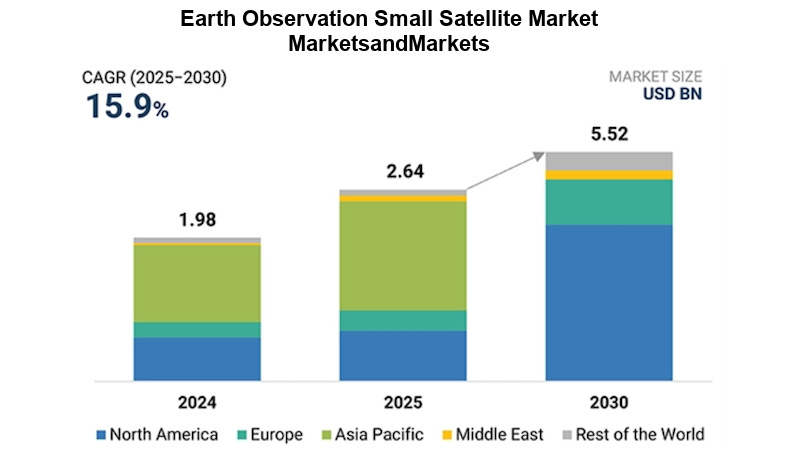
The Earth Observation Small Satellite Market is projected to grow from $2.64 billion in 2025 to $5.52 billion by 2030 at a CAGR of 15.9%, according to a new report from MarketsandMarkets. The increasing need for high-frequency Earth observation data drives the EO small satellite market. This data supports planning across defense, environmental management, and commercial analytics.
The mini satellite (101-1200 Kg or ≈222-2,650 pound) segment is expected to account for the largest market share in the EO small satellite market during the forecast period. The growth is driven by the segment’s ability to accommodate large EO payloads and maintain favorable development and launches. Mini satellites offer higher power availability and sensor capacity, enabling good imaging performance. As mission requirements evolve toward higher resolution, the demand for mini satellites is expected to increase during the forecast period.
The satellite bus segment is projected to account for the largest market share in the EO small satellite industry during the forecast period. The growth is driven by the increasing demand for modular, reliable, and power-efficient bus platforms. This helps support specific payloads and longer mission durations. Enhanced subsystem integration, such as advanced power systems, onboard processing, and thermal management solutions, further strengthens adoption. Satellite buses also enable flexible configurations, allowing operators to scale from single-mission assets to multi-satellite constellations.
The Asia Pacific is projected to account for the largest market share during the forecast period, driven by significant investments in national EO programs across China, India, Japan, and South Korea. The region’s growing need for satellite imagery to support agriculture, environmental monitoring, defense surveillance, and disaster response is increasing the use of EO small satellites in the region. Competitive manufacturing and launch ecosystems are further reducing mission costs and attracting new commercial operators. As regional governments expand their commercial sector, the Asia Pacific region is expected to lead the adoption of small EO satellites globally.