

Earth-Observation Satellite Reaches Orbit, Completing Constellation’s Commercial Threshold
EDC-08 Joins Seven Earlier Satellites as Company Eyes Commercial Service Later This Year

An eighth satellite for a planned Earth-observation constellation reached orbit and made initial contact with ground controllers, bringing the system to the satellite count the company says it needs for commercial operations.
“EDC-08 reaching orbit and establishing initial contact is another important step in the disciplined deployment of the EarthDaily Constellation.”
Don Osborne, EarthDaily
EarthDaily, a Vancouver, British Columbia-based Earth observation company, said the satellite, EDC-08, launched July 9 aboard SpaceX’s Transporter-17 rideshare mission. The company called it “Launch III” for the EarthDaily Constellation, following an earlier deployment in May of six satellites, EDC-02 through EDC-07.
Commercial operations are expected later this year, according to the company. Those six earlier satellites are still moving through commissioning and calibration, and EarthDaily has not set a specific date for when commercial service will begin.
Each spacecraft in the constellation, including EDC-08, carries 16 imagers collecting data across 22 spectral bands, according to the company. EarthDaily said the system is designed to produce daily, globally consistent imagery for change detection, with images calibrated against the Sentinel and Landsat satellite archives to reduce inconsistencies caused by weather, viewing angle and sensor differences.
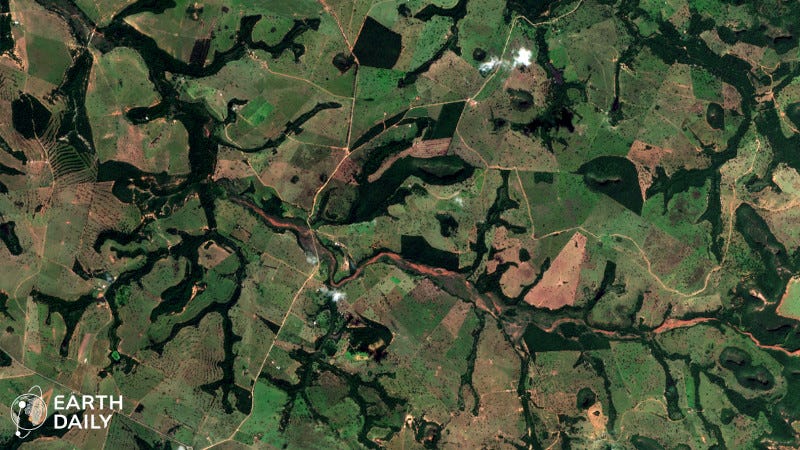
Alongside the EDC-08 announcement, the company released what it described as initial imagery from the six May satellites, including an image of farmland in Mato Grosso do Sul, Brazil, that the company said was captured April 29.
“EDC-08 reaching orbit and establishing initial contact is another important step in the disciplined deployment of the EarthDaily Constellation,” said Don Osborne, chief executive officer of EarthDaily. “With eight satellites now in orbit, seven progressing through commissioning, and initial imagery returning from the May launch, the system is performing as expected.”
Osborne said the constellation’s calibration approach is intended to keep atmospheric conditions, viewing geometry and sensor differences from introducing noise into time-series data used in artificial-intelligence applications.
The company said the constellation, once complete, is intended to support customers in agriculture, defense, natural resources, climate risk and infrastructure monitoring. EarthDaily did not disclose how many satellites remain to reach full planned constellation size or when subsequent launches are scheduled.