

Dream Chaser Spaceplane Completes Launch Acoustic Milestone at Kennedy Space Center
Testing Simulated Rocket-Launch Sound and Vibration Ahead of First Orbital Mission

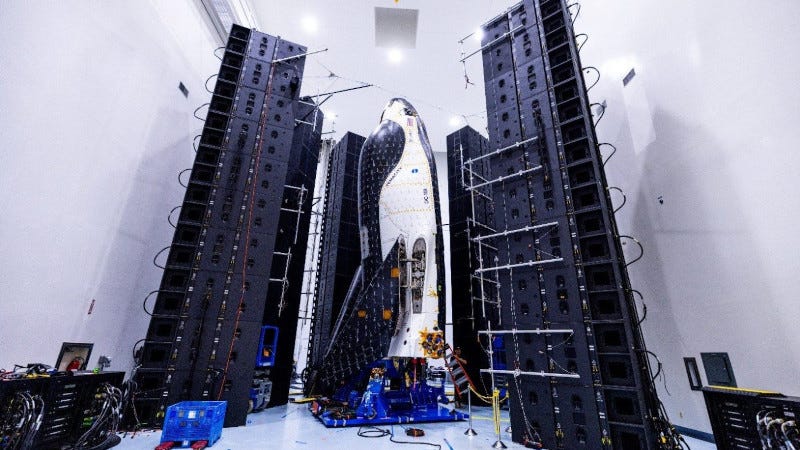
Launch acoustic testing has been completed on the Sierra Space Dream Chaser spaceplane, marking a key step toward the vehicle’s first flight to low Earth orbit. The test was conducted at the Space Systems Processing Facility and was designed to verify that the spacecraft, named Tenacity, can withstand the intense sound and vibration environment expected during launch.
“We believe Dream Chaser represents a transformative capability for space-based civilian and national security operations.”
Dr. Dan Polis, Sierra Space
The test used an array of 90 stacked speakers to reproduce the acoustic and airborne vibration loads the vehicle would encounter on a rocket. During the test, Dream Chaser was configured with its wings stowed, matching the way it would be positioned inside a 5-meter payload fairing for launch. Sierra Space said the milestone confirmed both the durability of the spacecraft’s critical electronic systems and the structural integrity of the vehicle.
“We believe Dream Chaser represents a transformative capability for space-based civilian and national security operations,” said Dream Chaser program manager and Sierra Space VP of Engineering Dr. Dan Polis. “It is designed to carry both pressurized and unpressurized payloads, combined with reusability and gentle runway landings, making it ideal for critical and time-sensitive missions.”
The company said the spacecraft has also completed electromagnetic interference and compatibility testing, high-speed tow testing and a post-landing recovery rehearsal. It also demonstrated command-and-telemetry capabilities with mission control in Louisville, Colorado, using NASA’s Tracking and Data Relay Satellite System.
With acoustic testing finished, the spacecraft has been moved to Colorado for final modifications and mission-specific upgrades, the release said.
On its first mission, Dream Chaser is expected to operate as a free-flying platform in support of NASA’s Commercial Resupply Services-2 contract.