

Dawn Aerospace Strengthens Orbital Refueling Position
Reaches Agreements with Cosmoserve, Royal Netherlands Air and Space Force

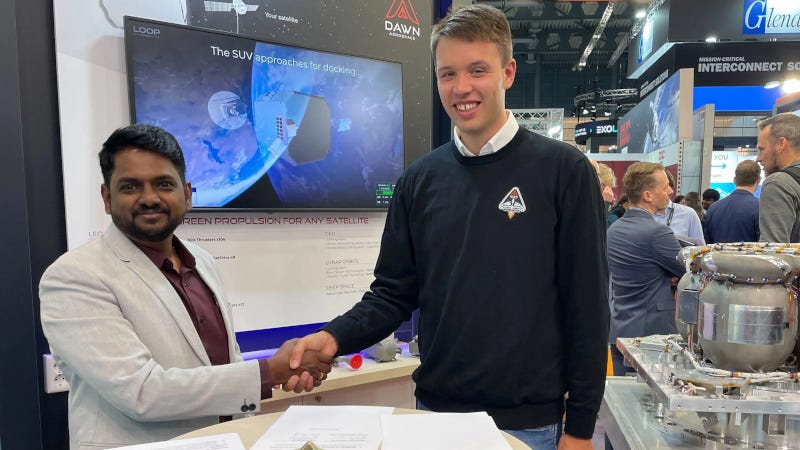
A pair of agreements with Cosmoserve and the Royal Netherlands Air and Space Force will help solidify Dawn Aerospace’s position in the orbital refueling space.
“Replacing toxic hydrazine-based propulsion systems has been our first major step to allow more sustainable and scalable propulsion in space.
Jeroen Wink, Dawn Aerospace
A Memorandum of Understanding was signed between Dawn and Cosmoserve at Space Tech Expo in Bremen, Germany to partner on enabling sustainable and scalable in-space servicing through refueling and debris removal technologies. The strategic MoU expresses both parties’ intent to explore future collaboration on integrating Dawn’s refuellable propulsion systems and in-space refueling service; Loop, with Cosmoserve Space’s debris capture and removal missions.
This partnership is grounded in a shared vision to enable sustainable and scalable in-space servicing, ushering in a new era for the space industry.
“Replacing toxic hydrazine-based propulsion systems has been our first major step to allow more sustainable and scalable propulsion in space. However, to facilitate a fully sustainable space industry with in-orbit servicing, in-space refueling is vital. This is why we are excited at the opportunity to work with Cosmoserve Space, as this is a key step towards enabling a circular space economy, where satellites and servicing vehicles can be refueled and redeployed instead of replaced,” said Jeroen Wink, Co-founder and CRO of Dawn Aerospace.
Active debris removal represents one of the most complex challenges in space operations, requiring precise maneuvering, extended mission durations, and reliable propulsion systems. By combining Dawn Aerospace’s refueling and propulsion capabilities with Cosmoserve Space’s debris-removal platforms, the partnership aims to enhance mission endurance and reduce the environmental impact of space activity.
“Dawn’s in-space propulsion solutions are a natural complement to our debris removal technology,” said Chiranjeevi Phanindra, Founder and CEO of Cosmoserve Space. “Through this collaboration, we can explore the utilization of Dawn’s systems in our in-space re-fueling depot – the Mothercraft for cost-effective and sustainable debris removal missions, ultimately helping preserve the usability of near-Earth space for future generations.”
The key focus area of the MoU includes the investigation of technical interfaces, operational synergies and potential future missions, using the core technologies of both companies.
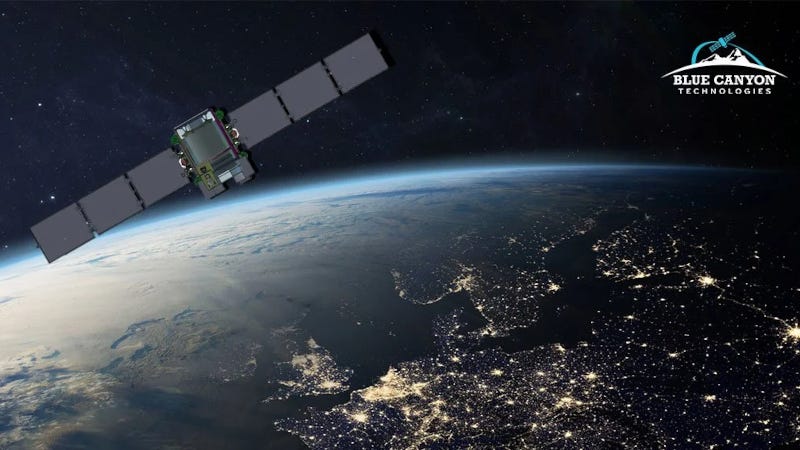
Also at the industry show, the Royal Netherlands Air and Space Force announced it has selected Dawn to provide its SatDrive propulsion system for the flagship PAMI-1 mission. Critically, the propulsion system will be equipped with Dawn’s Docking and Fluid Transfer (DFT) port, providing the Netherlands with its first sovereign satellite capable of being serviced and refueled in orbit.
The Armed Forces of the Netherlands are rapidly expanding their space capabilities. PAMI-1 provides a significant step towards establishing the Dutch capability to gather sovereign intelligence from space. The capability will also contribute to further strengthening international cooperations within NATO, EU and others. The satellite, PAMI-1, will support intelligence gathering for the Netherlands by offering a sovereign capability to monitor earth from space with high resolution instruments. PAMI-1 will also demonstrate laser satellite communication technology that provides fast and secure transfer of information, back to a ground station as well as to other satellites.
The PAMI-1 mission is the first of six satellites that form a constellation in Low Earth Orbit, with plans for further expansion.
“Space is critical for national security, and the Royal Netherlands Air and Space Force is greatly expanding their capabilities. We are honored to contribute to their flagship PAMI program,” said Jeroen Wink, co-founder and Director of Dawn Aerospace. “It is fantastic to see the Netherlands not just building sovereign space capability, but taking tangible, practical steps towards in-space servicing by incorporating this refueling-ready technology from day one.”