

Compact Deployable Optical Ground Station Completes Satellite Laser Link Trials
UK Defense Lab-Funded Field Tests Validate Transportable Lasercom System for Edge Deployment

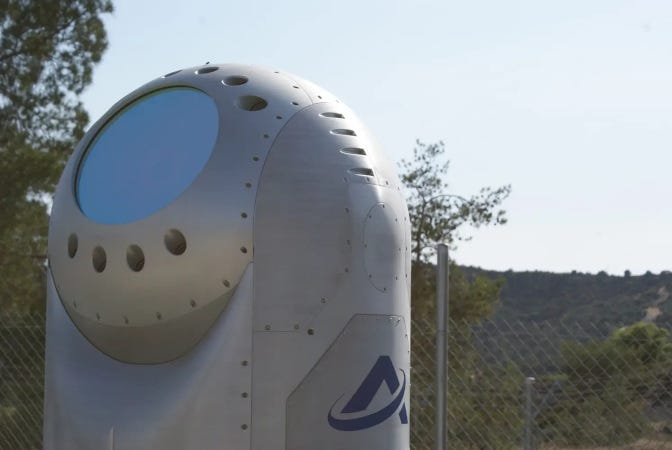
Successful field trials of what developers say is the world’s smallest deployable operational optical ground station have demonstrated secure, high-speed laser communications between a ground-based terminal and a satellite in low Earth orbit. The multi-day trials, conducted earlier this month in the Mediterranean region and funded by the UK’s Defense Science and Technology Laboratory, validate the TERRA-M system built by Archangel Lightworks.
“The TERRA-M is uniquely capable of rapid, secure data transfer with satellites while also being small enough to be deployed and redeployed at the point of need.”
Richard Johanson, Archangel Lightworks
The trials transferred data between the TERRA-M and a LEO satellite across multiple passes, with tests repeated to demonstrate reliability. The system used the U.S. Space Development Agency laser communication standard throughout, establishing interoperability with established government lasercom protocols.
The TERRA-M is a fraction of the size of conventional optical ground stations. Its optical head stands just 3.6 feet tall and 2.3 feet in diameter, and the unit requires no external dome or dedicated facility. The system can be transported by light vehicle or aircraft and deployed on a rooftop, making it suited for use at the edges of existing communications infrastructure where traditional stations cannot easily be sited. Its modular design supports interoperability with a wide range of lasercom standards and terminals.
UK Space Minister Liz Lloyd welcomed the results, saying the trials “show the UK is at the forefront of laser communications, developing the kind of cutting-edge products that will underpin the future of global connectivity.” Lloyd added that the government is proud to have supported the effort, noting the project strengthens national security, drives economic growth, and extends opportunity to underserved communities.
Richard Johanson, CEO of Archangel Lightworks, said the company is “on a pathway to providing resilient, large-scale deployable networks of optical ground stations,” and that demand for space-based information and connectivity “continues to grow exponentially.”
TERRA-M units and ground-station-as-a-service contracts are already being purchased and delivered to customers, according to the company.
Laser communications to and from satellites is increasingly central to next-generation space infrastructure. The technology supports high-volume, secure data transfer as an alternative to radio-based transmission and addresses rapidly growing satellite traffic. Key applications include satellite internet backhaul and earth observation data downlink, with further uses spanning space exploration missions such as NASA’s Artemis program. The technology serves both commercial and defense markets and avoids the physical vulnerabilities associated with terrestrial and undersea cable networks.
Archangel Lightworks is also supported by the UK Space Agency, the UK Department of Science and Technology, and the UK Ministry of Defense. The company holds memoranda of understanding with Starcloud and Omantel, as well as a number of commercial contracts.
Archangel Lightworks closed an oversubscribed Series A funding round last month, raising $13.5 million and bringing total funding to approximately $20 million. Investors include Santander Alternative Investments, the National Security Strategic Investment Fund, Blackfinch Ventures, Oxford Capital, Lycka Limited, and Oxford Science Enterprises.