

Communication Small Satellite Market May Reach $18.34 billion by 2030: Report
Driven by the Rising Need for Timely, High-Resolution Geospatial Intelligence

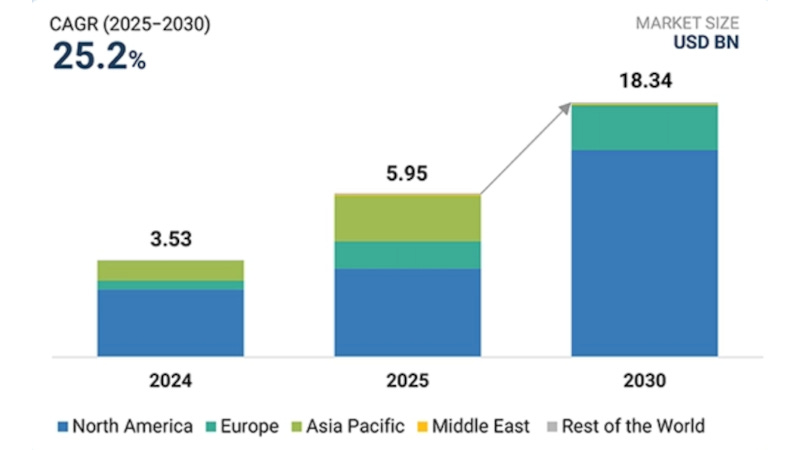
The communication small satellite market is projected to grow from $5.95 billion in 2025 to $18.34 billion by 2030 at a CAGR of 25.2%, according to a new report from MarketsandMarkets. The market is witnessing growth driven by the rising need for timely, high-resolution geospatial intelligence to support defense, climate monitoring, and commercial decision-making, according to the report.
Based on mass, the mini satellite (101-1,200 KG) (≈222-2,645 pound) segment is projected to account for the largest share of the communication small satellite market during the forecast period. The companies are adopting transmitters that offer a balance between payload capacity and launch costs. These mini satellites provide sufficient onboard power to enable communication throughput without the complexity associated with larger bus satellites. The size of the satellite is also suitable for the rapid deployment requirements of LEO constellations, where the replenishment cycle is short. As more users become involved in commercial and government communication coverage, the use of mini satellites is rising.
Based on system, the satellite bus segment is projected to account for the largest share of the communication small satellite market during the forecast period. System suppliers are giving importance to reliable platforms that can support communication payloads. Modern satellite bus architecture enables flexible integration of RF systems, processors, and power units required for high-speed missions. As the scale of LEO and MEO constellations increases, the dependence on standardized bus designs to reduce manufacturing time also increases. This trend toward efficient production and performance in orbit is driving demand for satellite bus platforms.
North America is projected to account for the largest market share during the forecast period, primarily due to significant investments in commercial broadband services and next-generation communication networks within the region. The region is home to OEMs, launch service providers, and operators that are driving the deployment of smallsat-based communication services. Government and defense initiatives further propel the market with their investments in secure satellite communication layers. These factors strengthen North America’s position in the communication small satellite market.