

Certification as Credibility
Why NASA and DoD Approvals Have Become Vendor Selection Tools for Enterprise Customers

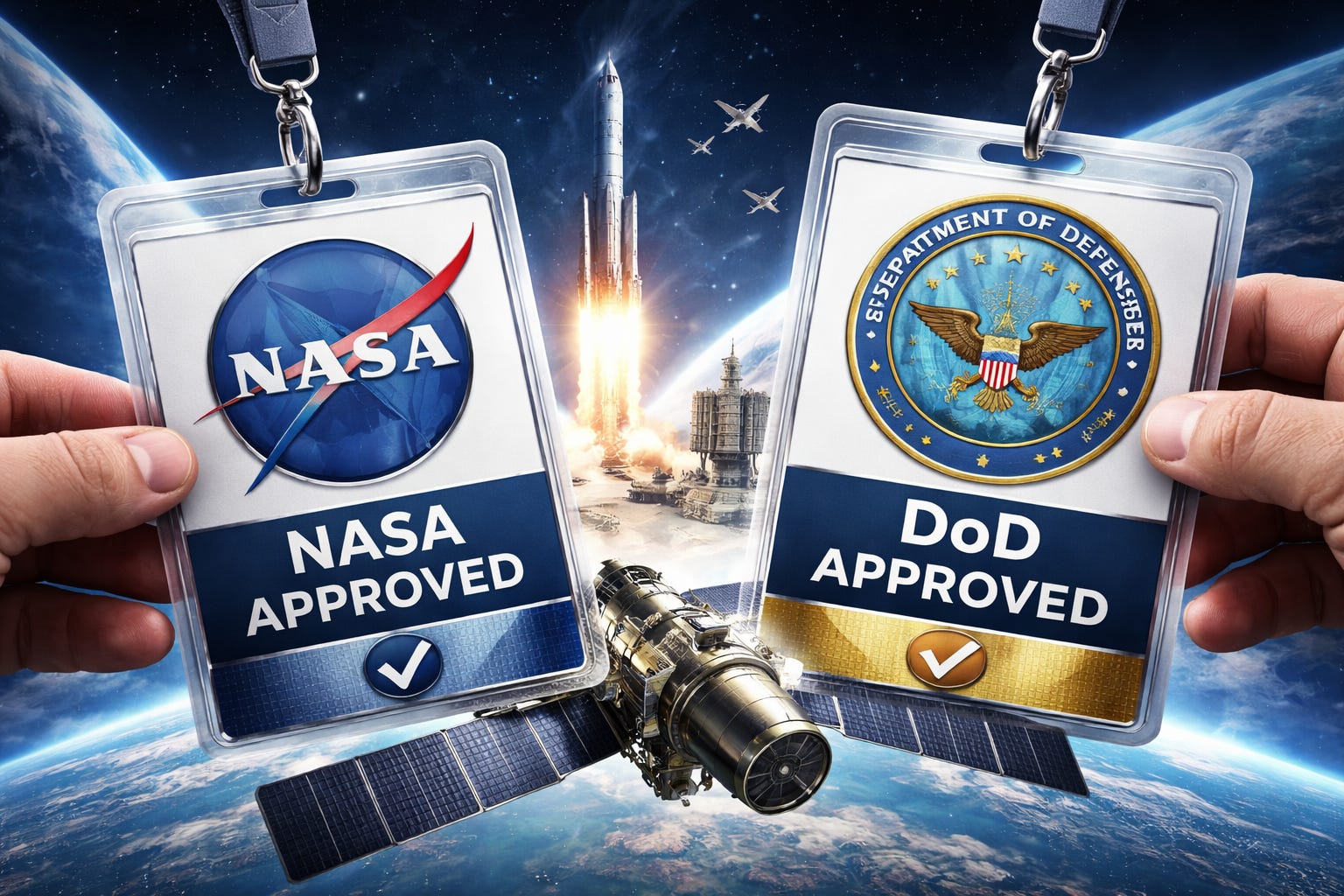
There was a time when capability spoke for itself. A company built something that worked, proved it in the field, and customers followed. That era is over. Today, in the high-stakes environment of advanced technology, aerospace, and complex systems, credibility is no longer inferred from performance alone. It is conferred. And increasingly, it is conferred by institutions that carry the weight of consequence-organizations such as NASA and the Department of Defense.
Enterprise customers are not merely buying products. They are buying risk mitigation. They are buying assurance. They are buying the confidence that comes from knowing that someone with far more to lose has already asked the hard questions, pushed the system to its limits, and signed their name to its viability. Certification, in this context, is no longer a compliance exercise. It has become a strategic asset. It is a signal, and in many cases, it is the signal.
The shift is subtle, but profound. When a company can say that its technology has been validated, tested, or deployed under the scrutiny of NASA or the DoD, it is no longer engaging in marketing. It is borrowing institutional trust. These organizations do not operate in theoretical environments. They operate where failure is public, expensive, and often irreversible. A rocket does not get a second chance. A defense system does not get to fail quietly. The standards required to survive in these environments are not aspirational. They are existential.
Enterprise buyers understand this. They may not fully grasp the technical intricacies of a propulsion system, a communications architecture, or a cybersecurity framework, but they understand risk. They understand consequence. And they understand that if a solution has been accepted into the operational ecosystem of NASA or the DoD, then it has passed through a filter that few others could replicate on their own. In a world of increasing complexity, that filter becomes a shortcut to trust.
This is where certification evolves into a form of brand currency. It is no longer buried in the technical documentation or relegated to a compliance appendix. It moves to the front of the conversation. It becomes part of the narrative. “Tested by NASA.” “Approved for DoD deployment.” These are not just statements. They are positioning tools. They reframe the entire value proposition from one of potential to one of proven reliability.
But there is a danger in misunderstanding what this means. Certification is not a substitute for strategy. It is an amplifier. Without a clear value proposition, without a defined market position, and without a disciplined approach to customer engagement, even the most prestigious validation can become noise. The market is beginning to saturate with claims of affiliation, partnership, and testing. The difference lies in how these certifications are contextualized.
The companies that understand this do not simply announce their credentials. They translate them. They connect the rigor of NASA’s validation process or the DoD’s operational requirements directly to the customer’s world. They answer the implicit question: What does this mean for me? It means reduced integration risk. It means shorter procurement cycles. It means fewer unknowns in deployment. It means that the system has already been stress-tested in environments that exceed your own.
In this sense, certification becomes a bridge between two very different worlds. On one side is the institutional environment of government agencies, with their layers of oversight, testing protocols, and mission-critical imperatives. On the other side is the enterprise customer, navigating budget constraints, internal politics, and the constant pressure to deliver results without failure. Certification translates the language of one into the confidence of the other.
There is also a psychological dimension that cannot be ignored. Enterprise decision-makers operate under scrutiny. Every major vendor selection carries career implications. Choosing an unproven provider, even if technically superior, introduces personal risk. Choosing a vendor with NASA or DoD validation, on the other hand, provides a form of professional cover. It is easier to defend. It is easier to justify. It aligns the decision-maker with institutions that are widely respected and understood.
This is not about laziness or a lack of due diligence. It is about efficiency in an environment where the cost of being wrong is high. Certification becomes a heuristic. It simplifies complexity. It allows decision-makers to move forward with a degree of confidence that would otherwise require extensive internal validation efforts. In many cases, it accelerates the entire procurement process.
However, this dynamic also raises the bar for companies seeking to compete in these markets. It is no longer enough to be innovative. It is not even enough to be effective. There is an increasing expectation that serious vendors will have some form of institutional validation. This creates a divide between those who have navigated the certification landscape and those who have not. It becomes a gatekeeping mechanism, whether intentional or not.
For emerging companies, this presents both a challenge and an opportunity. The challenge is obvious. Gaining access to NASA or DoD programs, navigating their requirements, and achieving meaningful validation is resource-intensive. It requires time, capital, and a level of organizational maturity that many startups are still developing. But the opportunity is equally significant. Once achieved, this validation can serve as a force multiplier, opening doors that would otherwise remain closed.
The strategic question, then, is not whether certification matters. It clearly does. The question is how it is integrated into the broader brand strategy. Companies must decide whether they will treat certification as a milestone or as a cornerstone. The difference is critical. A milestone is something you achieve and move past. A cornerstone is something you build upon.
When certification is treated as a cornerstone, it informs messaging, sales strategy, partnership development, and even product design. It becomes part of the company’s identity. It shapes how the organization thinks about quality, reliability, and customer expectations. It creates a discipline that extends beyond the initial validation and into every aspect of the business.
There is also a long-term implication that is often overlooked. As more companies achieve these certifications, the differentiation they provide will begin to erode. What is now a competitive advantage may become a baseline expectation. When that happens, the focus will shift again. The market will begin to ask not just whether you have been certified, but how you have leveraged that certification to deliver superior outcomes.
This is where the next layer of strategy emerges. Certification gets you in the room. Performance keeps you there. The companies that will lead in this environment are those that understand both. They will use certification to establish credibility, but they will not rely on it as their sole differentiator. They will continue to innovate, to refine their offerings, and to deepen their understanding of customer needs.
In the end, certification as credibility is a reflection of a broader trend. Trust is becoming institutionalized. In a world where information is abundant but certainty is scarce, organizations look to entities that have the authority, the resources, and the accountability to validate what works. NASA and the DoD represent the pinnacle of that validation in their respective domains.
For enterprise customers, their approval is not just a technical endorsement. It is a strategic signal. It says that the technology has been tested where it matters most. It says that the vendor has met standards that are not negotiable. And perhaps most importantly, it says that choosing this vendor is a decision that can be made with confidence.
That is the real power of certification. It does not just prove that something works. It makes it easier for others to believe that it will.
About the Author

Michael Daily is the President of NewSpace Brand Builders, a strategic consultancy dedicated to advancing the branding, marketing, and communications excellence of the global space industry. With an extensive background in brand strategy, public affairs, and community strategy development, Daily established NewSpace Brand Builders to help organizations define their identity, strengthen their market position, and contribute to a sustainable and innovative space ecosystem. You can reach Mike at mike.daily@newspacebb.com or visit https://newspacebrandbuilders.com/
 | A guest post by
|