

BAE Systems Holds the Only Radiation-Hardened Processor That Matters
What the RAD750 Bottleneck Means for ADCS and Star Tracker Production Schedules Right Now

What This Means:
Every attitude determination and control system (ADCS) and star tracker destined for a radiation-hardened mission profile runs through a single qualified processor: the BAE Systems RAD750. That is not a design preference, it is a procurement reality enforced by flight heritage requirements, export controls, and a qualification barrier measured in years, not months. As constellation programs scale and small satellite manufacturers push into higher-radiation orbits, the RAD750’s production capacity is becoming the quiet ceiling on how fast the industry can actually grow. Supply-chain leaders and C-suite executives managing programs with radiation-hardened requirements should be auditing their processor lead times and teaming structures now, before 2027 manifests lock.
The Signal
Late in 2023, the Space Development Agency (SDA) delayed Tranche 1 satellite deliveries by nearly a year, citing production shortfalls across the space supply chain. Radiation-hardened components were explicitly named among the contributing constraints. The SDA’s Tranche 1 delay was not an isolated procurement failure. It was a diagnostic. A single processor was sitting at the center of most of the affected ADCS and avionics subsystems, and the companies waiting for it had no qualified alternative to turn to.
That processor is the BAE Systems RAD750. It has been flying on spacecraft since 2001. It powered the Mars Reconnaissance Orbiter, the Lunar Reconnaissance Orbiter, the Curiosity rover, and hundreds of defense and intelligence satellites, a claim consistent with mission heritage documentation and Class 2 trade reporting, but not independently confirmed in a single Class 1 aggregate source. Its flight heritage is the reason it is specified. Its heritage is also the reason replacing it requires a qualification campaign that, at government programs, takes between three and seven years and costs tens of millions of dollars.
Understanding why that combination creates a structural supply-chain risk requires mapping the processor’s position in the stack, the qualification economics that protect it, and the production capacity constraints that translate single-source status into schedule exposure for every program depending on it.
The RAD750 in the ADCS Stack
An attitude determination and control system is the subsystem that tells a spacecraft where it is pointing and adjusts that pointing to meet mission requirements. It integrates sensor inputs from star trackers, sun sensors, magnetometers, and inertial measurement units (IMUs), runs navigation and control algorithms, and commands reaction wheels, magnetorquers, or thrusters to make corrections. The computational heart of that integration, on any mission operating above low Earth orbit’s (LEO) lower radiation bands or in the South Atlantic Anomaly or polar-orbit high-fluence zones, is a radiation-hardened processor.
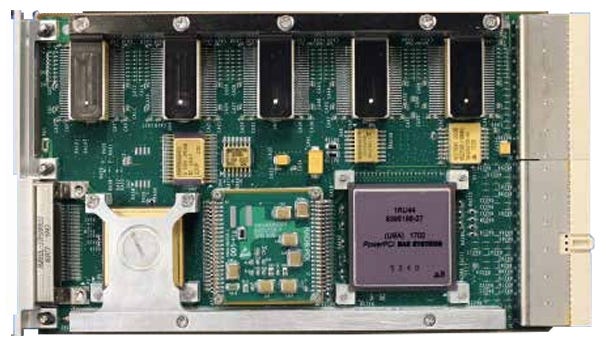
The RAD750 is a single-board computer built on a radiation-hardened PowerPC 750 architecture. BAE Systems produces it at its Manassas, Virginia facility. The processor is rated to operate in total ionizing dose environments up to one megarad, handles latch-up immunity across heavy-ion environments, and carries a mean time between failures measured in decades of on-orbit operation. No other processor in production today carries the same combination of flight heritage, radiation tolerance, single-event upset (SEU) rate, and export-compliant qualification documentation.
Star trackers, the optical sensors that establish spacecraft attitude by reading star field patterns, carry their own onboard processors for image acquisition and catalog matching, but their primary navigation output feeds into the ADCS computer. In most mission architectures, that computer is the RAD750. Blue Canyon Technologies (BCT), the leading U.S. small satellite ADCS supplier, integrates the RAD750 or its predecessor the RAD6000 into its flight-qualified attitude control units. Sinclair Interplanetary and Surrey Satellite Technology Limited (SSTL) have built systems around commercial-grade processors for lower-orbit commercial missions, but neither carries the full qualification stack for U.S. government radiation-hardened programs.
The implication is structural: any U.S. government mission requiring radiation-hardened ADCS processing is effectively a RAD750 mission. The supplier map collapses to a single node.
Why Single-Source Status Is Locked In
Single-source dependencies in aerospace are common. They persist when switching costs are prohibitive relative to procurement volume. For the RAD750, three switching-cost categories operate simultaneously.
