


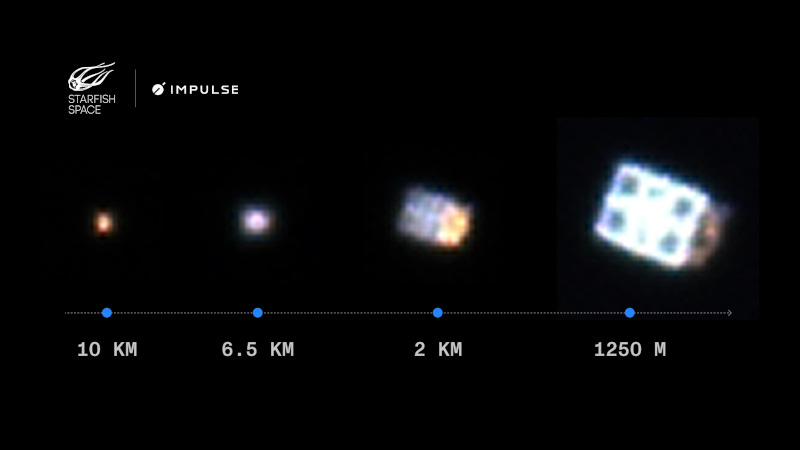
The newly-revealed ‘Remora’ mission has been completed by Starfish Space and Impulse Space. Remora validated key Starfish software for autonomous satellite guidance and showcased Impulse’s precise maneuvering capabilities.
“With Remora, we set out to validate our unique approach to autonomous rendezvous and proximity operations in orbit.”
Dr. Trevor Bennett, Starfish Space
The Remora mission marked an industry first: a fully autonomous rendezvous executed by Starfish with a single lightweight camera system and closed-loop guidance, navigation and control software running on a peripheral flight computer. The mission was conducted using Impulse’s Mira spacecraft that was flown on the Impulse LEO Express 2 mission. Starfish’s payloads enabled Mira to perform close-proximity maneuvers with another Impulse Mira spacecraft on orbit, which had been previously used for the LEO Express 1 mission. During operations in LEO, Starfish software autonomously controlled the LEO Express 2 Mira, guiding the satellite through a series of maneuvers which ultimately brought it to within approximately 1,250 meters of the LEO Express 1 Mira.
Historically, RPO missions have required large spacecraft outfitted with multiple complex sensors. Remora took a different approach, operating with just a single visual-range camera as the only sensor.
The Remora mission served as on orbit validation of Starfish’s core guidance, navigation and control (GNC) software suite, CETACEAN and CEPHALOPOD, which together enable fully autonomous RPO and docking. These systems will power Starfish’s upcoming Otter satellite servicing missions launching for SES, the U.S. Space Force, NASA, and additional customers. By successfully executing RPO with advanced autonomous software rather than heavy, specialized hardware, Starfish proved that it can conduct precise orbital operations more efficiently, safely and affordably than legacy approaches.
Throughout the autonomous RPO, images captured by an onboard camera supplied by TRL11 were continuously processed by Starfish’s CETACEAN computer vision software to generate real-time relative position estimates. These estimates were then used to compute optimal trajectories and command Mira’s thrusters to fire accordingly. As new images were captured, the process repeated in a closed loop, enabling fully autonomous guidance and control throughout the maneuver.
“With Remora, we set out to validate our unique approach to autonomous rendezvous and proximity operations in orbit,” said Dr. Trevor Bennett, Co-founder of Starfish Space. “Proving this capability is a major milestone for Starfish, and gives us tremendous confidence as we move toward our first Otter launches next year.”
The mission also showcased the precise maneuvering capabilities of Impulse’s high-thrust spacecraft, Mira. The eight onboard Saiph thrusters offered 176 N of total available thrust (increased to 208 N on the newly upgraded Mira vehicle), while cold-gas RCS thrusters provided 6 DOF attitude control. Enabling an approach of less than 1,300 meters, Mira proved its agility and capability to handle complex operations throughout the course of the Remora mission.
“Mira is our agile, responsive spacecraft. Its maneuverability and high thrust make it perfectly suited for this type of mission,” said Eric Romo, Impulse Space President and COO. “Together with our partners at Starfish, we brought this mission from concept to execution in less than a year. Our team is ready and able to execute quickly and deliver versatile, complex operations where success is paramount. We’re looking forward to more RPO missions across more orbits in the future.”
This operation also highlighted the flexibility of both the Starfish and Impulse platforms. Starfish software and hardware payloads successfully integrated with Impulse’s Mira spacecraft, demonstrating the compatibility and ease-of-use of both systems. This modular compatibility positions Starfish and Impulse to enable a wide range of future RPO missions.
The Remora mission was developed in just nine months, from initial concept to launch readiness. It quietly launched aboard SpaceX’s Transporter-12 rideshare on January 14, 2025. Starfish and Impulse worked in close coordination throughout the mission, collaborating across teams and moving quickly through design, testing, commissioning and operations. Starfish and Impulse conducted the mission without any prior public announcement, focusing fully on rapid and successful mission execution.