


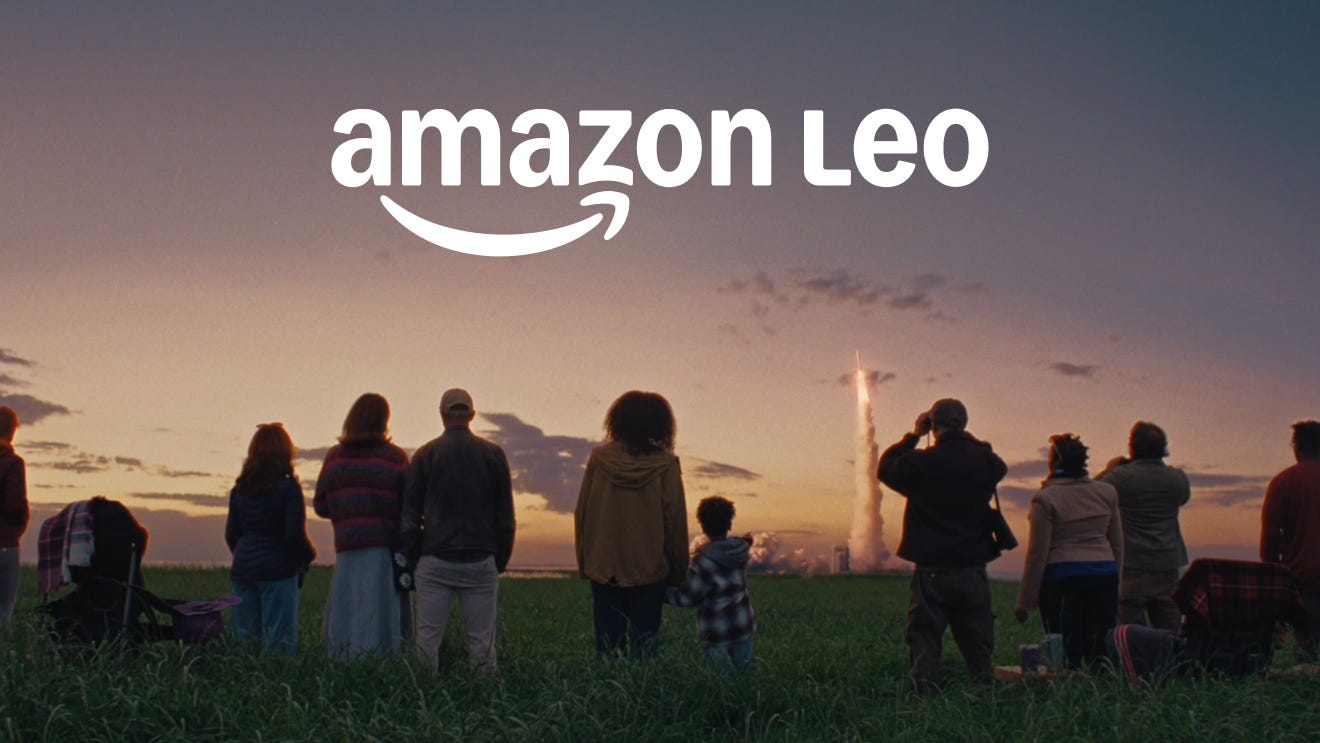
WHAT THIS MEANS
Amazon’s reported $9 billion pursuit of Globalstar is not a satellite story. It is a spectrum story. Band n53, the Apple direct-to-device pipeline, and Globalstar’s $273 million in 2025 revenue represent infrastructure Amazon cannot build on any timeline that matters. If the deal closes, it reframes Amazon Leo’s entire commercial arc -- and the competitive calculus for every D2D-adjacent holding in your portfolio. If it doesn’t, the bid itself has already repriced Globalstar’s spectrum assets and surfaced SpaceX as a counter-bidder. Either outcome is a signal investors need to act on now.
The Signal
On April 1, 2026, Globalstar’s stock surged more than 24 percent to an 18-year high on reports that Amazon was in advanced talks to acquire the satellite operator for approximately $9 billion. Some readers likely saw the date and raised an eyebrow. It was not a joke.
It was a signal.
Amazon’s reported pursuit of Globalstar -- a deal the Financial Times first detailed and Reuters confirmed -- would be the most consequential consolidation move in commercial satellite history since SoftBank wrote a $32 billion check for ARM in 2016. Not because of what Globalstar is, but because of what it has: Band n53 spectrum, a direct-to-device pipeline already activated through a landmark Apple partnership, Globalstar’s $273 million in 2025 revenue, and an existing LEO constellation Amazon could fold into its own infrastructure on day one. For investors watching Amazon Leo -- the company’s commercial broadband constellation -- the bid reframes every assumption about Leo’s commercial timeline, its competitive position against Starlink, and the speed at which Amazon’s $17 billion LEO capex commitment starts generating auditable AWS revenue.
The question is not whether Amazon wants Globalstar. The question is whether $9 billion buys what Amazon thinks it’s buying, and what the answer means for how you’re positioned right now.
What Amazon Leo Actually Needs
To understand why Globalstar is attractive, you have to understand where Amazon Leo stands without it.
As of early April 2026, Amazon Leo had approximately 241 satellites in orbit following the LA-05 Atlas V launch on April 4 that added 29 more spacecraft, with LA-06 and an Ariane 64 mission both planned for later in the month. Amazon officially operates the third-largest satellite system in orbit and holds a 100-plus mission launch manifest. The FCC has set a hard deployment milestone of 1,616 satellites by July 30, 2026 -- a threshold that determines whether Leo retains its full licensed spectrum rights or faces a material license modification. That gap, roughly 1,375 satellites in under four months, is the number sitting on every serious Leo watcher’s desk right now.
To its credit, Amazon has been moving. The company committed approximately $17 billion in total constellation capex, built out a dedicated processing facility in Florida, and secured launch capacity across multiple providers. The first meaningful commercial service phase is underway, with signed agreements already in place with JetBlue (service 2027) and Delta Air Lines (service 2028) -- two commercial timelines that give the FCC milestone deadline real business consequences beyond the regulatory paperwork. But meaningful is not the same as scaled, and scaled is not the same as competitive with Starlink, which has more than 10,000 satellites in orbit and established revenue streams across consumer broadband, aviation, maritime, and government services.
This is the structural context that makes Globalstar’s Band n53 spectrum so strategically valuable. Spectrum is the one thing Amazon cannot build its way into on a short timeline. You can manufacture satellites faster. You can contract more launches. You cannot manufacture spectrum rights that already exist, have been coordinated internationally, and are actively deployed through a major consumer electronics partnership.
The FCC’s own posture on spectrum scarcity makes this plain. In a recent episode of the Journal of Space Commerce podcast, FCC Space Bureau Chief Jay Schwartz addressed the demand environment directly: “There is enormous demand for spectrum... the enormous demand that’s coming really being as a result of the enormous prosperity that can be promised by a lot of these activities.” The FCC has responded by proposing over 20,000 megahertz of new spectrum across four bands -- upper 12 GHz, 41 GHz, 42 GHz, and the W-band above 95 GHz -- through its spectrum abundance rulemaking. But those bands are years from commercial deployment. Globalstar’s Band n53 is available now, coordinated now, and generating revenue now. That is not a nuance in the deal math. It is the deal math.
The Apple Factor
If spectrum is the floor of the Globalstar acquisition thesis, Apple is the ceiling.
Globalstar operates under a partnership with Apple that provides the emergency SOS and direct-to-cell functionality on newer iPhone models -- a relationship backed by Apple’s $1.5 billion investment in Globalstar in 2024, which gave Apple a roughly 20 percent equity stake in the company. That investment structure is not a detail in the footnotes. It is the single most important fact in the deal analysis. Amazon would not be acquiring a company with an Apple contract. It would be acquiring a company in which Apple is a sitting equity holder with presumptive change-of-control rights and a direct financial interest in how any acquisition is structured.
Every iPhone with emergency SOS capability is, in effect, already a satellite terminal. The question is who controls the spectrum layer enabling that connection. If Amazon completes the acquisition, it gains a path -- pending renegotiation with Apple and any exclusivity review -- into hundreds of millions of consumer devices already in market. Amazon would not just be selling broadband through AWS enterprise agreements. It would have a direct-to-device distribution channel at consumer scale that no other enterprise cloud operator can match.
On that same Journal of Space Commerce podcast episode, Schwartz described the long-term D2D convergence trajectory: “Long term, I could see this being just another extension of this sort of ubiquitous global network connecting everyone everywhere.” That future is already partially monetized through Globalstar’s Apple relationship. The full conversation with Schwartz -- which covers the FCC’s thinking on spectrum consolidation and D2D licensing dynamics in detail -- is available now on all major podcast platforms. It is worth your time before the next AWS earnings call.
This is also why the Globalstar deal has attracted attention beyond Amazon. MarketWatch reported April 2 that SpaceX may also have interest in the asset. If SpaceX is circling Globalstar, it is not for the legacy constellation. It is for Band n53 and the Apple pipeline. The same assets that Amazon wants for Leo, SpaceX would want to deny Leo while folding them into Starlink’s direct-to-device ambitions. A competitive bid from SpaceX would not just raise the acquisition price. It would reframe Globalstar’s standalone spectrum valuation upward across every D2D-adjacent holding in the satellite broadband sector.
The AWS Revenue Ledger Problem
There is a reason Amazon Leo has received relatively limited investor scrutiny compared to Starlink. Amazon does not break out Leo capex or revenue as a standalone line item. Leo costs are embedded in the company’s capital expenditure disclosures, and any early revenue flows through the AWS segment -- a segment that already generates tens of billions of dollars annually and can absorb Leo’s initial contribution without it registering as a visible signal.
Amazon Leo represents a rare case among major LEO constellations: it has a public financial reporting mechanism through AWS segment disclosures, which in theory allows investors to track commercial activation as the constellation scales. The reality is that AWS’s scale makes Leo’s early revenue contribution nearly invisible in current reporting. That changes only when Leo reaches commercial density -- roughly the 3,200-satellite tier where broadband service quality becomes consistently competitive with fiber in underserved markets.
A Globalstar acquisition accelerates that timeline by giving Amazon Leo an existing, revenue-generating satellite network to report against. Globalstar turned profitable in 2025 with approximately $273 million in revenue -- a real income statement, not a projection. But the acquisition also complicates the signal. Globalstar’s revenue profile, driven primarily by the Apple partnership and narrowband IoT services, would blend into AWS reporting in ways that make it difficult to isolate Leo’s broadband performance as a standalone indicator. Investors who want clean Leo visibility may find a post-acquisition AWS segment harder to read, not easier.
The first real data point arrives soon. AWS Q1 2026 earnings are expected in April or May 2026. Whether Globalstar is part of Amazon by then or not, watch the AWS segment reporting carefully. Any revenue language that references connectivity services, satellite broadband, or infrastructure licensing against external commercial customers will be the earliest quantitative signal of Leo’s commercial traction.
Three Risks That Do Not Show Up in the Headlines
The April 1 coverage was largely enthusiastic about the deal’s strategic logic. The risks deserve equal attention.
The valuation gap. At approximately $9 billion, Amazon is paying a significant premium over Globalstar’s standalone operating value. Seeking Alpha’s April 4 analysis flagged that stripped of the Apple contract, the spectrum strategic premium, and the acquisition halo, Globalstar’s underlying asset base does not obviously justify a $9 billion price tag. The Apple D2D contract terms, renewal risk, and exclusivity provisions are not publicly disclosed. Amazon may be buying a partnership relationship that has significant contingencies attached to any change-of-control transaction -- and with Apple holding roughly 20 percent of Globalstar’s equity, those contingencies are not hypothetical. If Apple has material renegotiation rights, or simply does not want its primary satellite partner acquired by a direct competitor in cloud and retail, the foundational revenue case for the acquisition changes substantially.
The FCC review timeline. Any acquisition of Globalstar requires FCC approval of the spectrum license transfer. As examined in detail in The FCC’s Hardest Call (Ex Terra JSC, March 26, 2026), the FCC’s posture toward large spectrum transactions has been shaped by competing pressures: a mandate to promote competition, a chairman-level priority on boosting the space economy, and a regulatory calendar that does not bend easily to deal timelines. In his Ex Terra podcast interview, Schwartz was direct about the FCC’s philosophy: “You never want a situation where we’ve put a regulation in place that has the effect of preventing a beneficial gain from private negotiation between two parties.” That framing is friendly to the deal in principle. But a spectrum transfer of this scale -- involving a band also of strategic interest to SpaceX, AT&T, T-Mobile, and potentially others -- will not move on Amazon’s preferred timeline. Listeners who want Schwartz’s full thinking on exactly this kind of spectrum consolidation pressure should pull up the Ex Terra podcast episode. A review measured in quarters rather than weeks creates real execution risk against Leo’s July 30 FCC deployment milestone.
The integration architecture problem. Globalstar’s existing constellation operates on fundamentally different orbital parameters, ground infrastructure, and spectrum coordination frameworks than Amazon Leo’s purpose-built NGSO design. Merging the two requires coordinated satellite operations across different orbital planes, spectrum sharing agreements with existing licensees, ground station reconfigurations, and in some cases hardware modifications to user terminals. Companies that have navigated similar LEO integration challenges have consistently reported that integration timelines exceeded deal timelines. For Amazon, which is already racing the FCC’s July 30 milestone clock, any operational distraction created by a $9 billion integration process is a risk that does not appear anywhere in the deal rationale headlines.
The Historical Playbook Amazon Is Running
Amazon has done this before, though not in space.
The Whole Foods acquisition in 2017 was not primarily about groceries. It was about physical distribution infrastructure and an established customer base that Amazon could integrate into its Prime and AWS logistics architecture. Amazon paid $13.7 billion for a network of 470 stores it could not have built at that speed organically, then immediately leveraged the purchase to accelerate same-day delivery, Prime membership value, and grocery category penetration. The Globalstar acquisition follows the same architecture: buy the physical infrastructure and the customer relationship that would take years to build from scratch, then integrate both into the broader Amazon platform.
The SoftBank-Sprint deal of 2013 offers a less flattering parallel. SoftBank paid $21.6 billion for spectrum access and a customer base, reasoning that scale would close the quality gap with AT&T and Verizon. The spectrum was real. The integration challenges were larger than modeled. Sprint never closed the gap, and the eventual T-Mobile merger a decade later represented a partial exit from the original strategic thesis. The cautionary read for Leo: spectrum access is necessary but not sufficient. The execution challenge of integrating Globalstar’s architecture while simultaneously scaling Leo’s own constellation to FCC milestone requirements creates a parallel-path operational burden that SoftBank-Sprint executed poorly.
AT&T’s DirecTV acquisition in 2015 may be the most structurally relevant precedent. AT&T paid $67 billion for a distribution asset -- a way to deliver content to consumers without depending on competitors’ infrastructure. The strategic logic was sound. The execution produced a decade of balance sheet drag, subscriber losses, and eventually a spinoff that returned DirecTV to near-standalone status. For Amazon, the faster-moving competitor is Starlink, which has years of head start, an operational launch infrastructure at SpaceX unmatched in launch cadence, and a defense revenue base that subsidizes commercial pricing in ways Leo cannot replicate through AWS alone.
What the FCC’s Spectrum Agenda Means for the Long Game
One dynamic that has received limited attention in the deal coverage is the FCC’s own spectrum expansion agenda and what it means for Globalstar’s strategic premium over a five-year horizon.
The FCC’s spectrum abundance rulemaking -- approved unanimously by the full commission -- proposes over 20,000 megahertz of new allocations across four bands. In the Ex Terra podcast episode, Schwartz confirmed both the scope of the rulemaking and the institutional priority behind it: “The chairman is very focused on boosting the space economy... we are working very hard on figuring out how we can make sure that there is enough available spectrum for these activities so that they can deliver more, better broadband, better other types of connectivity.” If those bands are eventually opened for commercial LEO operations -- even partially -- the scarcity premium embedded in Globalstar’s Band n53 position diminishes over time. Amazon would be paying $9 billion today for a spectrum asset whose relative scarcity value could be reduced by regulatory action within the deal’s investment horizon.
Schwartz also noted on the podcast that the World Radio Conference in 2027 will have 80 percent of its agenda items focused on space -- the most space-heavy WRC agenda in the organization’s history. Spectrum coordination at the ITU level for new bands takes years and requires multilateral agreement. Globalstar’s Band n53 has that international coordination already completed. That is genuinely difficult to replicate on any short timeline, and it remains a durable part of the asset’s value regardless of what the FCC’s domestic rulemaking produces. The full Ex Terra podcast conversation with Schwartz covers the WRC 2027 dynamics and the FCC’s international coordination posture in detail -- available now on Spotify, Apple Podcasts, YouTube, and Rumble.
Decision Questions
For investors with AMZN exposure: The Globalstar acquisition, if completed at $9 billion, would represent Amazon deploying an additional $9 billion on top of its $17 billion Leo capex commitment. That is $26 billion in total LEO infrastructure investment before the constellation has demonstrated a single quarter of scaled commercial revenue. Does your investment thesis on AMZN price that capital deployment as a value creator or a drag, and what AWS Q1 2026 revenue disclosure would change that assessment?
For space broadband investors: SpaceX’s reported interest in Globalstar creates a spectrum auction dynamic with direct implications beyond Amazon. If Band n53 is contested by the two largest LEO operators, what is the floor repricing for D2D-adjacent spectrum assets across your portfolio -- including AST SpaceMobile, which holds its own spectrum position and direct-to-cell contracts? Does a contested Globalstar bid change your entry or exit timing on any of those names?
For executives evaluating Amazon Leo as a commercial partner or competitive threat: Amazon’s move from organic constellation deployment to M&A-driven spectrum acquisition is a meaningful shift in strategy. If Leo can buy spectrum faster than it can deploy satellites to earn it, the July 30 FCC milestone -- and what Amazon does or does not ask the FCC for in terms of accommodation during an active acquisition review -- becomes a critical signals window. Are you monitoring the FCC docket on Leo’s milestone compliance filing, and do you have a view on what a milestone modification request would signal about Leo’s organic deployment confidence?
The next hard data point: AWS Q1 2026 earnings. Watch for any revenue language tied to connectivity, satellite services, or external commercial infrastructure licensing. That single disclosure will tell you more about Leo’s actual commercial traction than any announcement Amazon has made since the constellation’s first launch.
Related Decisions
Pull the FCC docket for Amazon Leo’s milestone compliance status and flag any modification request filed during the Globalstar acquisition review window.
Map your portfolio’s D2D-adjacent spectrum exposure -- AST SpaceMobile, Globalstar equity holders, and any broadband infrastructure names -- against the Band n53 repricing scenario.
Review the AWS Q1 2026 earnings release for the first quantitative signal of Leo’s commercial revenue activation; set a watch on the connectivity services language in the AWS segment commentary.
Assess your partnership or commercial agreements with Amazon Leo against the possibility of a Globalstar integration delay extending Leo’s full commercial service date by 12 to 18 months.
Listen to the Ex Terra: Journal of Space Commerce podcast interview with FCC Space Bureau Chief Jay Schwartz for the regulatory framework context behind spectrum consolidation decisions of this scale.
Sources and References
SOURCES
Reuters. (2026, April 2). Amazon eyes $9 billion Globalstar deal to rival SpaceX’s Starlink, FT reports. Reuters.com.
CNBC. (2026, April 1). Globalstar stock pops on report Amazon is weighing an acquisition. CNBC.com.
Amazon. (2026, March 22). Amazon Leo set to accelerate satellite production and launch cadence. AboutAmazon.com.
Arianespace. (2026, March 23). Arianespace to launch another 32 Amazon Leo satellites with Ariane 64. Arianespace.com.
Ex Terra: The Journal of Space Commerce. (2026, March 26). The FCC’s Toughest Call. ExTerraJSC.com.
Ex Terra: The Journal of Space Commerce. (2026, January 7). Amazon’s $17B LEO Gamble. ExTerraJSC.com.
Ex Terra: The Journal of Space Commerce Podcast. (2026, April). Interview with FCC Space Bureau Chief Jay Schwartz. Available on Spotify, Apple Podcasts, YouTube, and Rumble.
TIER 2 SOURCES
Broadband Breakfast. (2026, March 10). Amazon’s Project Kuiper reaches 153 satellites after latest 24-satellite launch. BroadbandBreakfast.com.
Space Internet Solutions. (2026, April 3-4). Amazon Leo weekly updates April 04, 2026. SpaceInternetSolutions.com.
Seeking Alpha. (2026, April 4). Globalstar: Don’t buy Amazon’s possible takeover deal (NASDAQ: GSAT). SeekingAlpha.com.
Yahoo Finance. (2026, April 4). Amazon Globalstar talks raise questions for Project Kuiper and Globalstar. Finance.Yahoo.com.
MarketWatch. (2026, April 2). This space stock is hot -- and both Amazon and SpaceX may want to buy it. MarketWatch.com.
TradingKey. (2026, April 1). Amazon talks to acquire Globalstar: Can $9 billion deal challenge Starlink? TradingKey.com.
TrendSpider. (2026, April 2). GSAT stock soars to 18-year high on Amazon acquisition reports. TrendSpider.com.
SATNews. (2026, April 2). Amazon in reported talks to acquire Globalstar in $9 billion move to challenge Starlink. SATNews.com.
247 Wall St. (2026, March 23). Amazon is ready to take on Starlink in space-based broadband. 247WallSt.com.
HighSpeedInternet.com. (2026, March 20). How many Starlink satellites are in orbit. HighSpeedInternet.com.
Limitations and Gaps
Acquisition status as of April 7, 2026: Amazon-Globalstar talks are reported by Reuters and FT but not confirmed as a signed agreement. All acquisition-dependent claims are qualified accordingly.
Apple contract terms (renewal conditions, exclusivity provisions, change-of-control rights) are not publicly disclosed. The 20% equity stake figure is drawn from Tier 2 sources; investors should verify against Globalstar SEC filings.
Amazon Leo satellite count reflects April 4, 2026 status (241 satellites). Constellation count is changing weekly; verify against Amazon’s official press releases for the most current figure at time of investment decision.
Starlink satellite count (10,000+) is based on March-April 2026 tracking data; exact operational count varies by active vs. decommissioned satellites.
SpaceX’s interest in Globalstar is based on a single MarketWatch report (April 2, 2026) and has not been confirmed or denied by SpaceX.
AWS segment revenue attribution to Leo is inferred from Amazon’s reporting structure; Amazon does not publish Leo-specific financial disclosures.
FCC spectrum abundance rulemaking band figures (upper 12 GHz, 41 GHz, 42 GHz, W-band) are drawn from the Ex Terra JSC podcast interview with Jay Schwartz and represent proposed -- not finalized -- allocations.
Conflicts of Interest and Disclosures
Ex Terra: The Journal of Space Commerce has no financial relationship with Amazon, Globalstar, Apple, SpaceX, or any entity referenced in this article. The FCC Space Bureau Chief Jay Schwartz was interviewed on the Ex Terra podcast as part of editorial programming. No compensation was exchanged. The podcast interview was conducted independently of this article’s production.
Disclaimers
Investment Disclaimer: This article is published for informational and intelligence purposes only. Nothing in this article constitutes investment advice, a recommendation to buy or sell any security, or a solicitation of any investment decision. Readers should conduct their own due diligence and consult qualified financial advisors before making any investment decision.
AI Disclosure: This article was produced using an AI-assisted editorial workflow incorporating human editorial judgment, source verification, and voice review at each production stage. AI-generated content is estimated at under 35% of the final draft. All factual claims have been verified against cited sources. The article reflects the editorial standards of Ex Terra: The Journal of Space Commerce.
Related Reading
The FCC’s Toughest Call -- Ex Terra JSC, March 26, 2026 (exterrajsc.com)
Amazon’s $17B LEO Gamble -- Ex Terra JSC, January 7, 2026 (exterrajsc.com)
The Partnership Trap -- Ex Terra JSC, March 25, 2026 (exterrajsc.com)
The $75 Billion Displacement -- Ex Terra JSC, March 30, 2026 (exterrajsc.com)
Ex Terra Podcast: FCC Space Bureau Chief Jay Schwartz -- April 2026 (Spotify, Apple Podcasts, YouTube, Rumble)