

AFRL Partners With AI Startup to Diagnose Satellite Power Failures
New Agreement Tests Explainable AI Against Spacecraft Electrical Systems in Operationally Relevant Conditions

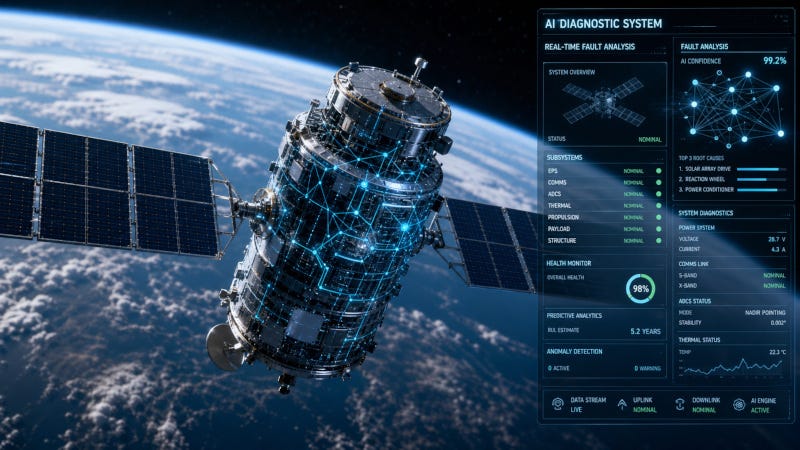
A Cooperative Research and Development Agreement between the U.S. Air Force Research Laboratory (AFRL) and Los Angeles-based PiLogic will test whether the startup’s “Exact AI” engine can diagnose and predict electrical and power failures aboard spacecraft platforms.
“Our technology gives engineers a clear, explainable understanding of system behavior.” Johannes Waldstein, PiLogic
The agreement gives PiLogic access to AFRL’s satellite testing platform to validate and refine its diagnostic models under conditions that mirror actual mission environments. AFRL’s Small Satellite Portfolio is overseeing the collaboration.
PiLogic will integrate its Exact AI inference engine into spacecraft electrical subsystem analysis. The system is designed to detect anomalies, predict failure modes, and recommend corrective actions. The stated goal is to reduce redesign cycles, improve satellite reliability, and strengthen what the laboratory describes as space mission assurance.
The collaboration focuses on a persistent problem in both government and commercial satellite programs: most AI diagnostic tools operate as what engineers call “black boxes,” producing outputs without traceable reasoning. PiLogic’s approach uses mathematically rigorous, explainable reasoning that shows engineers not only what might fail, but why — and with measurable confidence levels.
“Space missions demand both reliability and transparency,” said Johannes Waldstein, CEO of PiLogic. “Our technology gives engineers a clear, explainable understanding of system behavior, essential not just for defense, but for the rapidly expanding commercial satellite economy.”
Joseph Melville, PhD, Satellite Autonomy Lead at AFRL, said the laboratory is looking beyond current diagnostic approaches. “We are excited to evaluate the next generation of autonomy for satellite health monitoring with true causal understanding,” Melville said. “Through agreements like this, we hope to build first-of-their-kind, highly autonomous satellite systems that are natively transparent and trustworthy to human operators.”
A CRADA is a formal mechanism the U.S. government uses to collaborate with private companies on research and development without a direct procurement contract. It allows both parties to share resources — in this case, AFRL’s satellite testing infrastructure and PiLogic’s proprietary AI technology — while retaining their respective intellectual property.
The distinction between explainable and conventional AI carries particular weight in satellite operations. A failure on orbit typically means total mission loss. Unlike ground-based systems, spacecraft cannot be physically serviced after launch in most cases, making predictive accuracy and engineering transparency critical to program economics. A satellite that fails prematurely can represent years of development time and hundreds of millions of dollars in sunk cost.
PiLogic positions its technology as applicable beyond the defense sector. Satellite manufacturers, operators, and space infrastructure providers face increasing pressure to compress development timelines and improve on-orbit reliability, particularly as commercial constellation operators scale to hundreds or thousands of spacecraft. Validating the Exact AI system in a defense research environment provides a reference point that commercial customers can assess independently.
The agreement does not include a disclosed financial value. No production contract or program-of-record transition has been announced.