

Aerospace Firm Advances Reusable Platform For Supersonic Flight Testing
Company Says Airborne Rig Can Expose Hardware To Conditions Ground Wind Tunnels Can’t Match

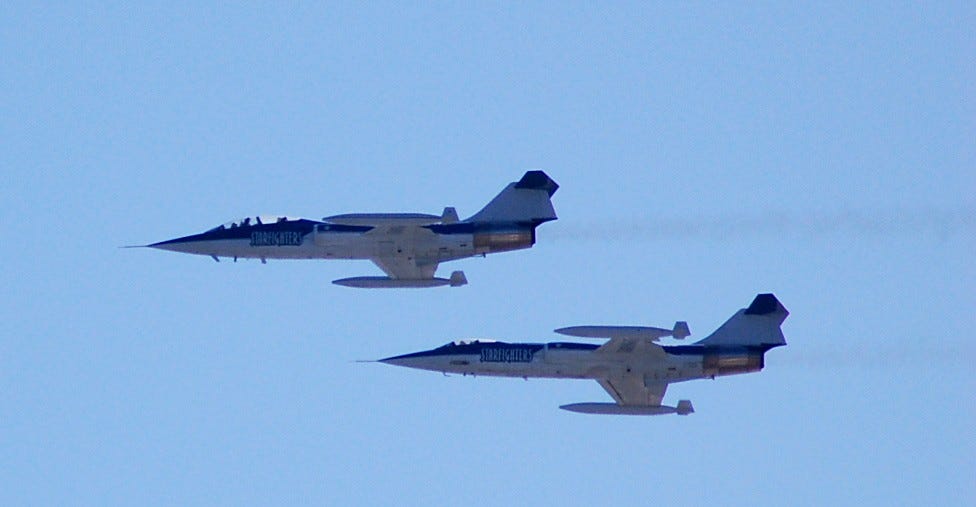
A company operating a fleet of supersonic jets is developing a reusable underwing platform meant to give aerospace and defense customers extended, real-atmosphere test flights at speeds above Mach 2.
“While ground wind tunnels remain essential for aerospace research and development, airborne testing can expose hardware to combinations of weather variation, vibration, acceleration, dynamic pressure, temperature and operational conditions that cannot always be fully reproduced in a fixed facility.”
Tim Franta, Starfighters Space
Starfighters Space (NYSE: FJET), based at NASA’s Kennedy Space Center in Florida, has announced the next phase of the project, called “Wind Tunnel in the Sky,” according to the company’s news release. The modular platform is designed to mount under the wing of the company’s F-104 aircraft and carry sensors, test articles and other payloads through sustained high-speed and low-gravity conditions.
A typical 45-minute mission could include up to a 10-minute window above Mach 2, according to the company. That is longer than a standard wind tunnel test run, which the company said typically lasts only seconds, and could compress testing that would otherwise require days of facility scheduling into a single flight, according to the release.
The underwing rig is expected to support aerodynamic test articles, avionics, sensors, communications systems, electronic equipment and advanced materials for hypersonic and microgravity research programs, the company said.
“As demand for hypersonic and advanced aerospace systems continues to grow, access to specialized test infrastructure remains limited, increasing demand for complementary commercial flight-test capabilities,” said Tim Franta, CEO of Starfighters Space. “While ground wind tunnels remain essential for aerospace research and development, airborne testing can expose hardware to combinations of weather variation, vibration, acceleration, dynamic pressure, temperature and operational conditions that cannot always be fully reproduced in a fixed facility.”
The project builds on the company’s earlier subsonic and supersonic flight-test work, including testing conducted for its STARLAUNCH 1 demonstrator, according to the release. Starfighters said the platform is still in development and, as it advances, is expected to expand commercial access to its F-104 fleet for defense, space and aerospace testing programs.
Starfighters operates its F-104 fleet from Kennedy Space Center and the Midland Air and Space Port in Texas. The company describes itself as the only commercial operator with the capability to fly at sustained speeds above Mach 2, a claim consistent with independent aerospace trade reporting on the company’s flight-test campaigns for customers including GE Aerospace.
No test date for the new platform has been announced.