

Advanced Rover Prototype Tests Autonomous Navigation for Moon and Mars Missions
NASA’s ERNEST Prototype Travels 16 Miles in Desert Field Test, Eyes Future Lunar Exploration

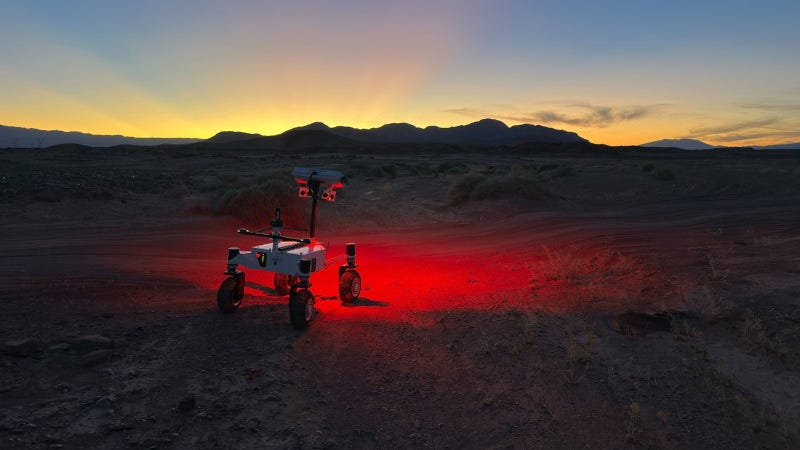
A compact four-wheeled rover prototype developed at NASA’s Jet Propulsion Laboratory is pushing the boundaries of robotic autonomy and terrain mobility, paving the way for future missions to the Moon and Mars.
“This testing is helping us refine the mobility hardware and autonomy software to navigate extreme distances across a wide range of terrain and lighting conditions.”
Issa Nesnas, JPL
The prototype, known as ERNEST, Exploration Rover for Navigating Extreme Sloped Terrain, recently completed a seven-day field campaign in the Colorado Desert of Southern California, covering 16 miles (26 kilometers) over 37 hours with minimal human intervention. That’s an order of magnitude faster than NASA’s current Mars rovers, Curiosity and Perseverance, can navigate.
“This testing is helping us refine the mobility hardware and autonomy software to navigate extreme distances across a wide range of terrain and lighting conditions anticipated on the Moon,” said Issa Nesnas, a principal technologist at JPL who led the testing as head of autonomy for a potential future long-range lunar rover mission concept.
The field campaign took place in March 2026 and included testing at dusk, dawn, and nighttime, conditions that produce long shadows similar to those found in the Moon’s polar regions. ERNEST reached speeds of up to 0.6 mph (1 kph), a significant leap beyond current rover capabilities designed to meet the demands of a potential high-distance lunar surface mission.
A New Approach to Rover Mobility
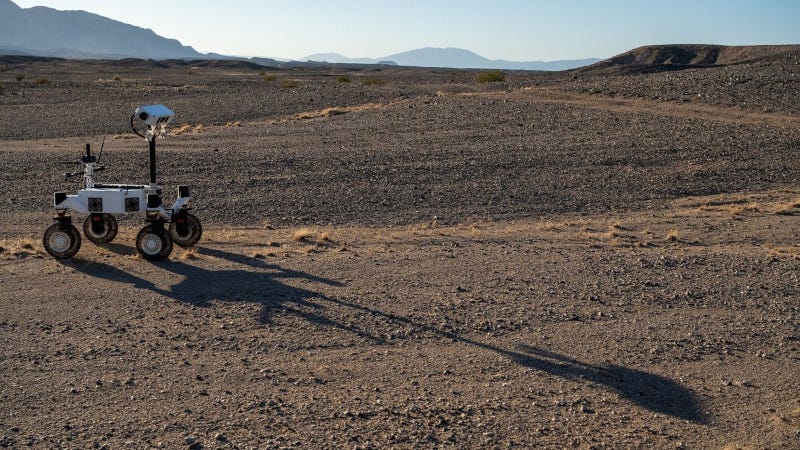
At 4 feet (1.2 meters) long, ERNEST represents a significant departure from the rocker-bogie suspension system used on every NASA Mars rover since Sojourner. While the rocker-bogie design passively keeps weight distributed across six wheels using pivot points and struts, ERNEST’s active suspension allows engineers to actively manage weight distribution among its four wheels. Two powered joints in front articulate a gimbal enabling different gaits, including squirming, wheel-walking, and obstacle-climbing, and a clutch mechanism lets the rover switch between active and passive suspension modes to balance terrain capability against energy efficiency.
“We started by postulating that we could do better in designing a planetary surface robotic mobility system,” said Hari Nayar, a JPL principal technologist leading the ERNEST team. “While the rocker-bogie system has been very successful over the past 30 years, there’s been a lot of research in that time on mobility and understanding terrain interaction.”
Before arriving at the current design, the team built two earlier prototypes, each about 2 feet (0.6 meters) long, to test 11 different active suspension configurations using lunar regolith simulant at varying slope angles before selecting a final design. Hardware for the current version was completed in September 2024.
Artificial Intelligence Trains the Rover to Think
To develop autonomous capabilities, JPL engineers turned to reinforcement learning, an AI approach where a robot learns by interacting with its environment. The Dynamics and Real-Time Simulation Laboratory at JPL created a high-fidelity virtual environment replicating ERNEST’s real-world behavior, running thousands of hours of simulations in a single weekend on a high-performance computing cluster. After months of virtual training, ERNEST successfully navigated an obstacle course of sand ripples, rubble piles, steps, and steep slopes in JPL’s Mars Yard entirely on its own.
“You could do a science road trip across the Moon, or Mars, with this vehicle,” said James Keane, a JPL planetary scientist working on lunar missions.
The ERNEST team is now launching a new autonomy project to integrate active suspension capabilities with longer-range intelligent navigation, enabling the rover to plan efficient paths around or through obstacles. Nesnas’ team is also using ERNEST to demonstrate the feasibility of building a rover twice its current size capable of a full long-distance lunar surface mission.
Work on ERNEST began in 2022 with JPL internal research and development funding and is currently supported by NASA’s Mars Exploration Program and the Exploration Science Strategy and Integration Office within the agency’s Science Mission Directorate. Caltech in Pasadena, California, manages JPL for NASA.