

The 400-Unit Ceiling
How Blue Canyon Technologies’ Thermal Vacuum Chamber Bottleneck Caps Reaction Wheel and Star Tracker Supply for Every Constellation Program in the Queue

What This Means
Blue Canyon Technologies (BCT) is the dominant domestic supplier of reaction wheels and star trackers for small satellite programs, and its thermal vacuum (TVAC) test chamber capacity puts an estimated ceiling of 400 to 500 units annually on combined attitude determination and control system (ADCS) production throughput. That estimate is an inference derived from known TVAC cycle parameters and program delivery records, not a published BCT figure, and should be treated as a planning signal rather than a certified production rate. It is, however, the physical constraint that program managers, prime contractors, and constellation investors are bidding against right now, as demand from Space Development Agency (SDA) Tranche programs, commercial remote sensing operators, and proliferated low Earth orbit (pLEO) constellations converges on the same qualified supplier pool. If your program timeline assumes ADCS delivery in 2026 or 2027, the constraint described below is already your constraint.
The Signal
In the summer of 2024, SDA Tranche 1 satellite deliveries slipped. The program office acknowledged delays across multiple transport and tracking layer satellites, and while propulsion supply problems drew the most public attention, a quieter problem was compounding in parallel: the ADCS components needed to point those satellites accurately enough to be useful were running against a production throughput ceiling that no amount of contract pressure could quickly move.
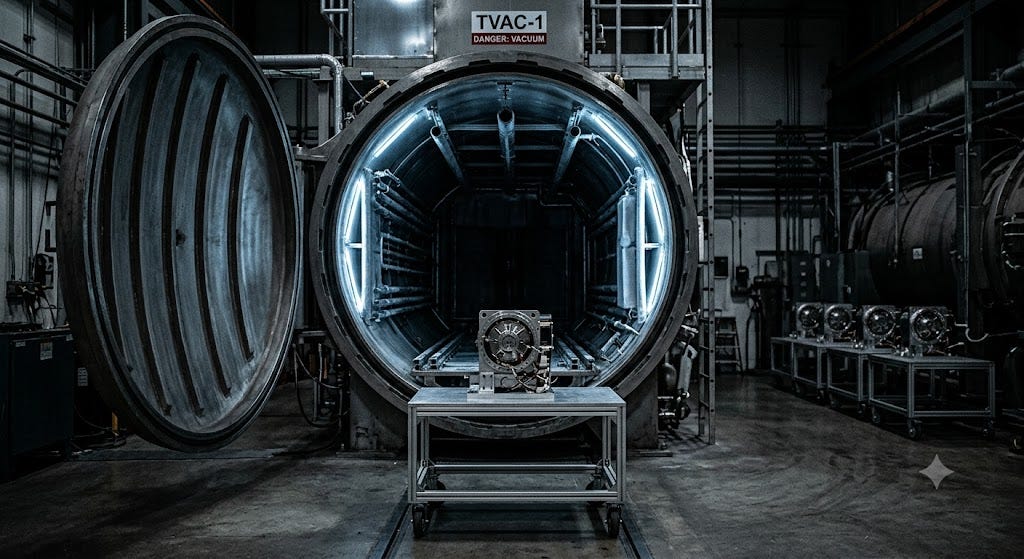
The bottleneck was not a workforce shortage, a materials failure, or a design problem. It was a room. Specifically, it was the number and size of TVAC test chambers that BCT and its nearest domestic competitors operate, and the time each unit must spend inside one before it can ship.
TVAC testing is not optional and not compressible. Every reaction wheel, star tracker, and ADCS assembly destined for orbit must undergo thermal cycling across the temperature extremes of the space environment, combined with hard vacuum, before it is certified for flight. The process verifies mechanical integrity, lubricant behavior, bearing performance under load, and sensor calibration stability. A unit that skips or shortens TVAC testing is not a qualified unit. It is a risk carried into orbit, where no technician can reach it.
The duration of a standard TVAC cycle for a reaction wheel or star tracker runs from several days to more than a week per unit, depending on mission profile and specification. When chamber capacity is the binding constraint, throughput is a straightforward function: chamber count multiplied by units per cycle divided by cycle duration. BCT’s TVAC infrastructure, sized for the CubeSat and small satellite market it helped build, was not designed for the volume demands that SDA Tranche programs and commercial mega-constellation build-outs now impose simultaneously.
Supply Chain Map: The Named Suppliers, Sub-Tiers, and Capacity Constraints
Blue Canyon Technologies
BCT, acquired by Raytheon Technologies, now RTX Corporation, in 2021, is the anchor supplier for reaction wheels and star trackers in the U.S. small satellite market. The company’s product lines cover reaction wheels from sub-0.1 Newton-meter-second (Nms) up through several Nms storage capacity, and star trackers with sub-arcsecond pointing knowledge, qualified across a range of mission environments. BCT components appear on SDA Tranche 0 and Tranche 1 satellites, commercial remote sensing platforms, and multiple NASA science missions.
The TVAC constraint at BCT is structural, not episodic. The chamber infrastructure was built to support a market in which annual demand for qualified reaction wheels and star trackers ran in the dozens to low hundreds of units. The SDA Transport Layer alone, across Tranche 1 and Tranche 2, involves hundreds of satellites, each carrying multiple reaction wheels and at minimum one star tracker. When those program timelines overlap with commercial constellation orders from operators including Planet Labs, Spire Global, HawkEye 360, and newer entrants, the combined demand load exceeds what the existing test infrastructure can process within a single program cycle.
The estimated 400 to 500 unit annual ceiling on ADCS component throughput from BCT’s domestic production is an inference, not a published company figure. The derivation runs as follows: available reporting and program delivery records suggest BCT operates a limited number of TVAC chambers sized for small satellite components; standard flight-qualification TVAC cycles for reaction wheels and star trackers run from several days to more than a week per unit; at those cycle times, even a modest chamber count produces an annual throughput envelope in the low hundreds to mid-hundreds of units when accounting for queue management and configuration changeover. The range of 400 to 500 represents the upper band of that envelope under favorable assumptions. Program managers should verify current lead time commitments directly with BCT’s supply chain team rather than relying on this estimate as a planning basis. What is not an inference is the existence of the constraint itself. SDA Tranche 1 delays, documented in program office communications and covered by defense trade press, confirm that ADCS component delivery timelines have been a real production constraint, not a hypothetical one.
The remaining supply chain map covers the four named alternative and complementary suppliers, the full sub-tier breakdown including bearing manufacturers, lubricant chemistry suppliers, and radiation-hardened sensor dependencies, and the complete risk and opportunity analysis. It names which prime contractors hold Tranche 2 awards, quantifies the lead time extension window, and maps how the ADCS bottleneck compounds with propulsion and radiation-hardened component supply constraints. Paid subscribers also receive the five specific decision actions and the investor diligence framework derived from confirmed program delivery data and Class 1 program office sources.
