

$720 Million and One Factory
Mapping the Supply Chain Risk Inside Apex’s Vertical Integration Bet

What This Means
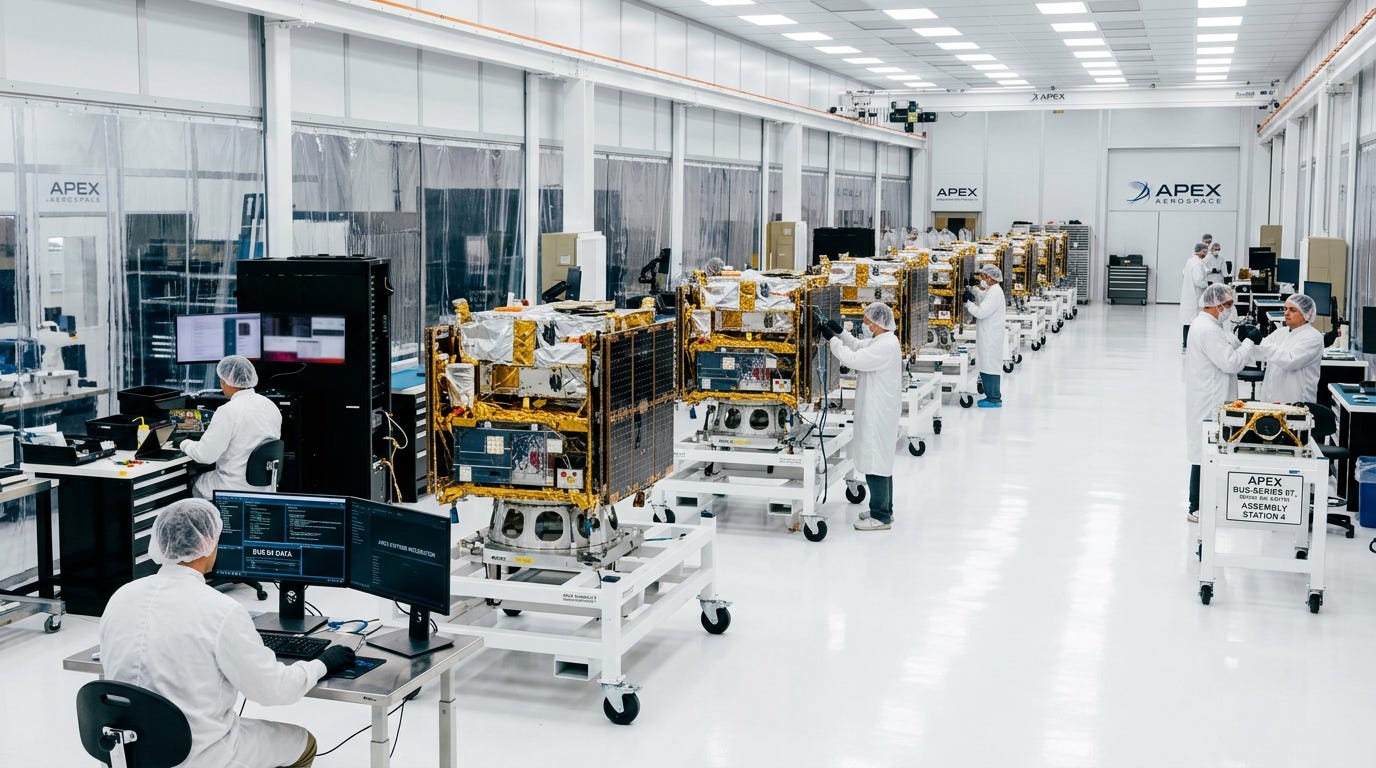
Apex has raised more than $720 million in 14 months and is targeting full vertical integration of its satellite bus by the end of 2026. That story is almost universally covered as a supply chain resilience play. The more precise read is a risk transfer. Every subsystem Apex pulls in-house replaces an externally distributed, multi-vendor market with a single internal production line at Factory One in Los Angeles. For constellation program managers with Apex buses in their manifest and investors pricing the company at $2.3 billion, the question is not whether vertical integration is efficient. It is whether your delivery timeline and your valuation model account for what happens when that internal line goes down.
The satellite manufacturing industry spent a decade building multi-vendor sub-tier networks specifically to buffer against single-source failures. If one supplier missed a delivery, a program manager could qualify a backup, absorb the delay, or renegotiate, and the damage stayed bounded to that one supplier relationship. Apex is now systematically dismantling that model, on purpose, with $720 million in investor backing and a stated target of full vertical integration by end of 2026.
If you manage a constellation program on an Apex bus or hold a position in the satellite bus market at its current $2.3 billion valuation, the integration story you have been reading is accurate and incomplete. What follows is the sub-tier map that should be in your program risk register and your valuation model.
Three Raises, One Strategy
On June 5, 2026, Apex announced it had raised more than $200 million in a new funding round led by Glade Brook Capital Partners and co-led by Washington Harbour Partners, with participation from existing investors. The round nearly doubled the company’s valuation to $2.3 billion, the third time in 14 months that Apex has raised approximately $200 million, bringing total capital raised to more than $720 million.
Each round has been earmarked for the same objective: build it yourself. The Series C, announced in April 2025, funded new platform development including the GEO Aries bus and the Nova and Comet platforms. The Series D, announced in September 2025, funded the insourcing of avionics, power systems, and propulsion — including the acquisition of Phase Four’s Hall-effect thruster (HET) technology. The June 2026 round is funding the next layer of the integration roadmap, though Apex has not yet publicly named which sub-tiers are next in line.
Ian Cinnamon, Apex’s chief executive officer (CEO), told an audience at the 2026 Upfront Summit that the company expects 70 percent of its subsystems to carry in-space heritage by mid-2026, with full vertical integration targeted by end of year. Factory One, which launched at 46,000 square feet when Apex moved into the Playa Vista facility in 2024, is targeted to exceed 100,000 square feet by the end of 2026. The stated production capacity target is 200 or more satellites per year — roughly four times Apex’s estimated 2025 output.
The pace is being driven, in part, by defense demand. In February 2025, the U.S. Space Force (USSF) awarded Apex a $45.9 million direct contract for satellite vehicle delivery across multiple orbital regimes, with performance obligations running through 2032. In October 2025, Apex self-funded a $15 million interceptor demonstration under the name Project Shadow, using its Nova platform, with a launch scheduled for June 2026. Apex was not among the 12 companies selected for the Space Force’s $3.2 billion space-based interceptor (SBI) prototype contract awards in April 2026, which makes Project Shadow a speculative positioning bet rather than a contracted program.
There is a version of the Apex story that is easy to tell. Cinnamon has described the goal as bringing Henry Ford-style mass production to spacecraft. That version is accurate. The part that gets less coverage is what happens to a supply chain when the manufacturer pulls every critical subsystem in-house and routes it through one factory. In automotive terms, Ford’s River Rouge complex was a marvel of vertical integration right up until a strike, a flood, or a fire reminded everyone that concentrating production in a single location is not resilience. It is efficiency with a specific failure mode.
The next sections map the specific sub-tiers not confirmed inside Factory One, the valuation model that depends on them, and the Golden Dome program adjacency that makes the timing risk concrete. Paid subscribers get the full sub-tier risk register and the named-supplier landscape.
