


What This Means
Europe has committed €131 billion to space investment, but the composite manufacturing infrastructure required to translate that capital into flight hardware does not exist at the necessary scale. Autoclave curing capacity across European and North American spacecraft composite fabricators currently supports production of four to eight complete spacecraft structures per month per facility, a figure drawn from conference-reported industry estimates and treated here as a directional ceiling, not a confirmed production specification, and that ceiling limits constellation growth to approximately 10 to 15 percent annually regardless of funding levels. Supply-chain leaders at U.S. primes sourcing composite bus structures, payload fairings, or primary structures for constellation programs face a concrete sequencing problem: capital is available, demand is real, but qualified fabrication slots are not. Executives and program managers who have not yet mapped their composite structure dependencies against available fabrication capacity should do so before the next constellation contract cycle locks manifest positions that the supply chain cannot physically support.
The Signal
In May 2026, the SmallSat Europe 2026 Business conference surfaced a data point that deserves more attention than it received: Europe’s composites manufacturing infrastructure cannot absorb the investment capital its member states have committed to space. The constraint is not materials availability, workforce skill in the abstract, or even funding. Autoclave time is the primary binding constraint, though as the cross-program context below makes clear, it does not operate alone.
An autoclave is a pressure vessel that cures fiber-reinforced composite structures under precisely controlled heat and pressure cycles. For spacecraft primary structures, payload fairings, solar array substrates, and antenna reflector dishes, autoclave curing is the production step that cannot be rushed, parallelized cheaply, or easily outsourced to an unqualified shop. Each cure cycle for a complete spacecraft bus primary structure takes between eight and twenty-four hours depending on laminate thickness, resin system, and part geometry. Loading, bagging, cycling, unloading, and inspection between runs means a single large autoclave at a qualified spacecraft fabricator realistically supports two to four complete primary structure sets per month under optimal scheduling.
That is the ceiling the supply chain is running into. And with the Space Development Agency (SDA), the National Reconnaissance Office (NRO), and multiple commercial constellation operators simultaneously demanding composite structures for programs ranging from Tranche 2 transport layer satellites to commercial Earth observation buses, the ceiling is no longer theoretical.
The Supply Chain Map
Understanding the bottleneck requires mapping it at three levels: raw material supply, prepreg and intermediate processing, and fabrication capacity.
Level 1: Raw Carbon Fiber
The carbon fiber supply chain for aerospace-grade composite structures is concentrated in three companies. Toray Industries of Japan holds the leading position in aerospace-grade polyacrylonitrile (PAN) precursor and finished carbon fiber, supplying T700, T800, and M55J grades used across spacecraft primary structure applications. Hexcel Corporation, headquartered in Stamford, Connecticut, produces both carbon fiber and aerospace prepreg systems, and its HexPly product line is qualified across multiple U.S. and European prime programs. Syensqo (the entity formed by the 2023 demerger of Solvay’s materials operations, formerly operating as Solvay Advanced Materials and before that as Cytec), rounds out the primary qualified supplier base for space-grade prepreg systems through its CYCOM product line.
These three suppliers are not interchangeable at the program level. Each resin system and fiber grade combination requires a separate qualification campaign, typically lasting 12 to 24 months and costing between several hundred thousand and several million dollars depending on the structural application. A prime that qualifies Toray T800/Hexcel 8552 prepreg for a specific structural application cannot substitute Syensqo CYCOM 5320-1 without repeating qualification testing. This requalification barrier means that supply concentration risk is not merely a spot-market problem. It is embedded in program documentation and cannot be resolved by purchasing authority alone.
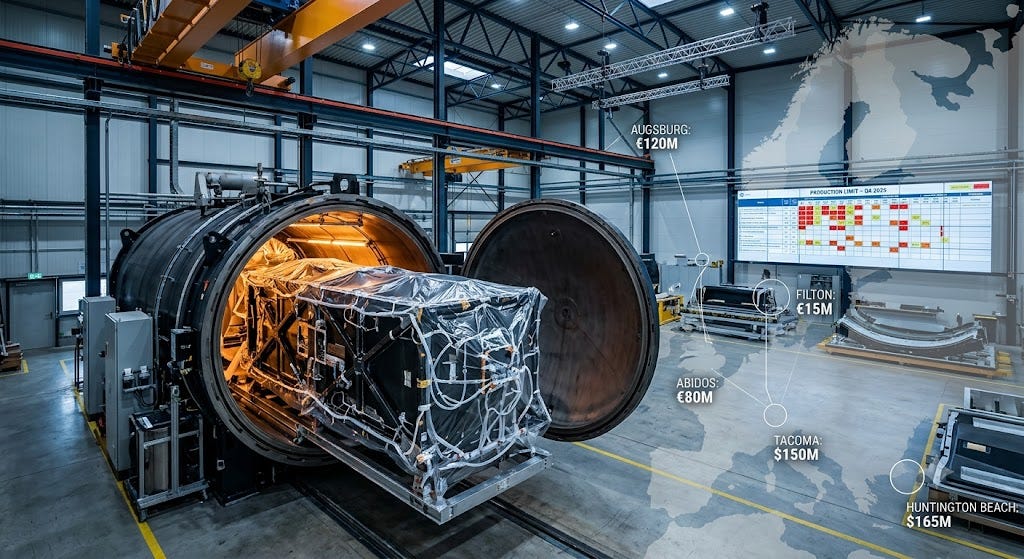
Toray’s aerospace fiber capacity is split across facilities in Japan, France (through Toray Carbon Fibers Europe in Abidos), and the United States (through Toray Composite Materials America in Tacoma, Washington). Hexcel operates manufacturing in Salt Lake City, Utah; Duxford, United Kingdom; and Parla, Spain. Geographic distribution provides some resilience, but aerospace-grade fiber production is not fungible with industrial-grade fiber. Production capacity at each qualified facility is a specific and finite number.
The next sections map the prepreg qualification barrier, the fabrication capacity ceiling by named facility, and the three concurrent supply chain constraints that amplify the composite bottleneck for SDA Tranche 2, NRO, and commercial constellation programs. Subscribers also receive the full decision framework, investment case analysis, and the specific actions program managers and supply-chain leaders should take before the next constellation contract cycle. This is decision-grade supply chain intelligence, not a news summary.
